

Auvers-sur-Oise · memory · visit guide
The grave of Vincent and Théo van Gogh in Auvers-sur-Oise
Two simple stones, the same carpet of ivy and a story that only ended in 1914, when the two brothers were finally reunited.
This guide recounts the burial of Vincent in 1890, the death of Théo six months later, the decisive role of Jo van Gogh-Bonger and the walking route which today connects the Auberge Ravoux, the church, the fields and the cemetery.

Where is Van Gogh's grave?
Vincent van Gogh and his brother Théo rest side by side in the municipal cemetery of Auvers-sur-Oise, northwest of Paris.
The tomb is located in the upper part of the village, at the back of the cemetery against the surrounding wall. It is immediately recognized by its two very sober inclined stones and the ivy which covers the two burials as a single living surface.
Vincent was buried in Auvers on July 30, 1890, the day after his death. Théo died in Utrecht on January 25, 1891 and was first buried there. It was not until April 14, 1914 that his widow Jo van Gogh-Bonger, had his remains transferred to Auvers to reunite the brothers.
Visiting the cemetery is free. It takes on its full meaning in a walk from the station or the Auberge Ravoux, passing by the church painted by Van Gogh and the fields of the plateau.
Two simple tombs that have become a universal image
There's nothing spectacular about the monument. Its strength comes from the proximity of the two names, the horizontality of the stones and the ivy which almost erases the separation.

The twin steles
The repetition of shapes gives the two burials the same visual weight. No heroic sculpture distinguishes the artist from his brother.
The dates
1853 -1890 for Vincent and 1857 -1891 for Théo: four years apart at birth, less than six months between their deaths.
Ivy
It crosses the boundary between the plots and materializes the union desired by Jo. Vegetation has become the emblem of the monument.
The cemetery wall
The tombs lean against the edge, facing the plateau. This rural setting recalls the fields painted over the last seventy days.
From Vincent's death to the brothers' reunion
The history visible today spans twenty-four years. It combines the drama of July 1890, the rapid disappearance of Théo and the memorial work of Jo.
→1914
Vincent arrives in Auvers-sur-Oise
After Saint-Rémy, he moved to the Auberge Ravoux. Doctor Gachet becomes his doctor. In seventy days, he produced seventy-three paintings and thirty-three drawings according to the Ministry of Culture.
The injury
Vincent leaves the hostel to work then returns in the evening with a gunshot wound to the chest. The doctors declare him untransportable and warn Théo.
Death at the Auberge Ravoux
Vincent died around 1:30 a.m., at thirty-seven, with Théo at his side. His coffin is surrounded by yellow flowers and his latest paintings.
The funeral in Auvers
Around twenty relatives, villagers and artist friends participate in the funeral. Émile Bernard, Lucien Pissarro, Charles Laval, Julien Tanguy, Doctor Gachet and Théo are among those cited by the sources.
Theo dies in Utrecht
Very ill, physically and psychologically exhausted, Théo disappeared less than six months after his brother. He is first buried in the Netherlands.
Vincent's concession is reorganized
The first fifteen-year concession is coming to an end. Jo ensures the sustainability of the place and prepares a lasting double burial.
Théo joins Vincent
At the request of Jo van Gogh-Bonger, Theo's remains were transferred from Utrecht to Auvers. The two brothers now rest side by side, the same year as the publication of the major edition of their correspondence.
Why is Theo buried with Vincent?
Funeral reunion doesn't just respond to family affection. It makes visible a collaboration without which Van Gogh's work would probably not have existed in this form.

The painter
Vincent tirelessly seeks a modern language of color. His letters combine health news, painting descriptions, exhibition projects, money questions and reflections on the artists he admires.
In Auvers, his activity remains intense. The panoramic landscapes, portraits of Doctor Gachet, gardens and views of the village show an artist in research, not a painter who has stopped working.

The brother, merchant and support
Théo sends money, pays for materials, keeps the paintings and maintains continuous correspondence with Vincent. An art dealer in Paris, he also understood exhibition networks and the birth of modern art.
Reducing him to the role of patron would be insufficient: he is Vincent's first reader, confidant and critical interlocutor. Jo will make this relationship known by publishing the letters and organizing the circulation of works.
Two similar stones say what the letters repeat for almost twenty years: Vincent's work is inseparable from the dialogue with Théo.Historical reading of the common burial
What does ivy mean on graves?
The plant is not a simple decor. Coming from the memory of the Gachet family, it physically connects the two burials.
a single living surface.
Loyalty, continuity and reunion
The ivy comes from the garden of Doctor Gachet's family. According to documents distributed by Paris Region and local sources, Paul Gachet fils made him run to the two graves to recall the bond of friendship and loyalty which unites Vincent, Théo and the Gachet family.
Its evergreen foliage has favored a symbolic reading: fidelity of the brothers, survival of the work and continuity of memory. But we must distinguish this symbolism from precise history. The concrete gesture comes after the meeting of the two bodies and is part of the maintenance of the monument.
Ivy changes with the seasons, as do bouquets, cards and small objects left by visitors. The tomb is therefore never a fixed image: it is constantly rewritten by vegetation and gestures of memory.
How to visit Van Gogh's tomb in Auvers?
The grave can be visited without a ticket. The main issue is the path: the cemetery is located on the plateau, above the center and the station.
Start from the center
From the train station or Auberge Ravoux, follow the signs to Notre-Dame-de-l'Assomption church.
Look church
Go around the building to compare its actual apse to the unstable construction painted by Van Gogh in June 1890.
Go up to the board
The path crosses the agricultural landscape which dominates Auvers. The fields count as much as the monument in the experience of the place.
Enter the cemetery
Join the back wall. The tombs are neighboring and very low; leave free passage to other visitors.
Take a break
Read both names, look at the ivy and place the dates in the timeline before photographing.
Return through works
Go down using the Painters' Path and its reproductions installed near several motifs.
Four places to understand the last days
The grave is just an arrival point. The Auberge Ravoux, the church and the fields make it possible to rebuild a work area concentrated over seventy days.

The Ravoux Inn
Vincent lives in room n° 5 in the attic during his last seventy days. He died there on July 29, 1890. The small room is today preserved and can be visited during the opening season.
Starting here allows you to measure the daily distance between an extremely bare room, the streets of the village and the immensity of the plateau. It's also the best place to understand that Van Gogh didn't live with Doctor Gachet.
See all houses in Van Gogh →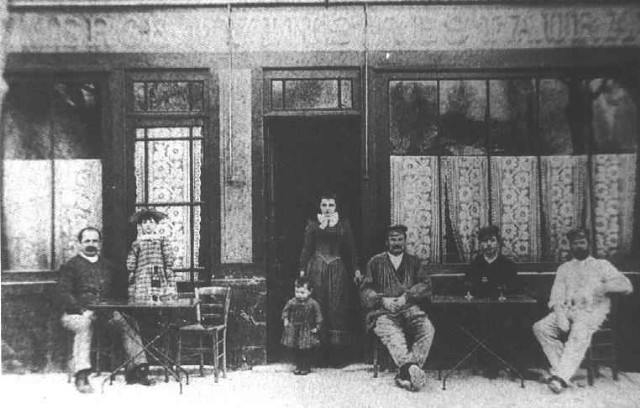


The actual church
The building dominates the village. By going around it, we find the apse chosen by Van Gogh, but not the undulations and breaks in color of the painting.
Official information →
The Auvers Church
The intense blue sky, the divergent paths and the almost liquid architecture transform the building into an unstable organism. The painting is kept at the Musée d'Orsay.
See reproduction →Works to keep in mind before arriving at the cemetery
These paintings do not constitute an exact account of the last days. They show the diversity of research carried out in Auvers: large horizons, gardens, architecture and framing without sky.


What the grave says - and what it does not prove
The place is charged with emotion, but its simplicity should not be transformed into automatic proof of a biographical story.
"Theo was always buried with Vincent"
False. Theo first rests in Utrecht. His transfer to Auvers took place in 1914, twenty-three years after his death.
"Crow wheat field is his last canvas"
Tradition has long affirmed this, but chronology does not demonstrate it. Tree roots is today considered the last probable work.
"Van Gogh no longer worked in Auvers"
Fake. Auvers production is extremely dense: seventy-three paintings and thirty-three drawings in seventy days.
"The tomb has always had its current appearance"
No. Concession, location, assembly of bodies, ivy and maintenance have a history. Old photographs show the transformations.
"It's an ordinary tourist attraction"
The site attracts visitors from all over the world, but remains an active communal cemetery and a place of contemplation.
"Jo just transferred Theo"
His role is much broader: organization of exhibitions, loans, sales, publication of letters and construction of Vincent's posterity.
Extend Auvers with the paintings
Find the painted landscapes around the village, then explore the boutique's important collections dedicated to Van Gogh, the fields, portraits and his latest works.
The Church Auvers-sur-Oise
Architecture, cobalt skies and divergent paths in one of the most expressive views of the village.
Wheat field with crows
A large horizontal format crossed by three paths and a heavy sky.
The Daubigny Garden
A luminous tribute to the master of Auvers.
Self-portrait with hat
The artist's gaze constructed in small colorful touches.
Historical documents and visit information
Dates and figures are checked as a priority in the resources of the Van Gogh Museum, the Musée d'Orsay, the Ministry of Culture and the tourist office.
- Van Gogh Museum · chronology of the last days
- Musée d'Orsay · Van Gogh in Auvers-sur-Oise
- Ministry of Culture · Vincent's Dream Museum
- Tourist office · map of Auvers 2026
- Tourist office · come to Auvers
- Van Gogh Letters · last unfinished letter
- Wikimedia Commons · photographs of tombs
- Alpha Reproduction · the houses of Van Gogh
Frequently asked questions about the tomb of the Van Gogh brothers
Where are Vincent and Théo van Gogh buried?
They rest side by side at the municipal cemetery of Auvers-sur-Oise, avenue du Cimetière, in Val-d'Oise. The graves are at the back of the cemetery against the surrounding wall.
Why is Théo buried in Auvers when he died in the Netherlands?
Théo died in Utrecht on January 25, 1891 and was first buried there. His widow Jo van Gogh-Bonger had his remains transferred to Auvers on April 14, 1914 so that he could rest with Vincent.
Is there a fee to visit the tomb?
No. The municipal cemetery is accessible free of charge during opening hours. It is prudent to check the access conditions with the town hall or tourist office before traveling far away.
How long does it take to get from the station to the cemetery?
Allow around twenty to twenty-five minutes on foot depending on the route and your pace. The last part goes up towards the church and the plateau.
Why are both tombs covered in ivy?
The ivy comes from the Gachet family garden. Paul Gachet fils makes him run to the two graves to recall the friendship and union of the brothers. It has become a symbol of loyalty and continuity.
Was Vincent buried directly at the current location?
The first concession was temporary and the organization of the monument is evolving. In 1905, the concession was redeveloped and perpetuated before Théo's transfer in 1914.
Can we visit Auberge Ravoux on the same day?
Yes during its opening season. The hostel is located in the center of Auvers. Room n° 5, where Vincent lived and died, can be visited according to official times.
Is Cornfield with Crows really Van Gogh's last painting?
It's not established. Tradition made it famous as the last painting, but current research points to it instead Tree roots like the last probable work, painted on July 27, 1890.
What attitude should we adopt in front of the grave?
This is an active cemetery. Speak softly, allow free access, do not walk on graves, do not pick ivy and avoid deposits that could damage stone or vegetation.
In Auvers, Van Gogh's story ends not in front of a single stone, but in the silent dialogue of two names.
The simplicity of the tombs reminds us that the painter's posterity was a collective work: that of Vincent, Théo, Jo and all those who preserved the paintings and letters.
Explore Van Gogh in Auvers-sur-Oise
0 comments