

Saint-Rémy · December 1889 · F 737 /JH 1862
Field enclosed by the rising sun: Van Gogh watches the day start again behind a wall
An almost empty field, a few furrows, a low wall and a pale sun. Van Gogh transforms the repeated view from Saint-jauPaul-jaude-jaMausole into one of his calmest paintings: not an escape, but a restart.

The short answer
A landscape from December 1889, painted from the same closed world observed all year round
The painting belongs to the large suite of fields seen behind the Saint Rémy asylum. It is today in a private collection and should not be confused with a spring version kept at the Kroeller jaumüller Museum.
What we see
The foreground is entirely occupied by plowed land where a young yellow wheat appears. Winding furrows start from the lower edge, tighten and rise towards a stone wall. Behind this limit appear a few houses, trees, a strip of purple hills and, almost in the center, a clear sun in a lemon and pink sky.
The painting does not tell of any action. There is no sower, no reaper, no walker. Yet everything moves: the furrows undulate, the keys respond to each other, the light rises. Van Gogh does not paint an abandoned field but a land that is beginning to produce again.
In a letter to his sister Willemien dated December 9 or 10, 1889, the artist precisely described this painting and described it, with the orchard in bloom, as "softest thing" he painted. This sentence must guide the reading more than the tragic interpretations given after his death.
Look slowly
Wall closes space, but sun reopens time
The composition is based on a simple contradiction: the view is materially limited, while the lines and color give the landscape endless energy.
Enter by land
The bottom edge is almost tactile. The pink, purple, ocher and green touches give the floor the thickness of a worked material.
Follow the furrows
The lines do not converge with academic regularity. They undulate, cross and accelerate the gaze towards the bottom.
Hit the wall
The stone forms a light band. It physically stops the field, but also serves as a hinge between near and far.
Raise your eyes
Hills and sun take up little space. Their calm responds to the agitation of the ground without canceling it.
Four plans
From the clod of earth to the solar disk
Depth doesn't come from perfect geometric design. It is born from a succession of rhythms, densities and colored temperatures.
Pink and purple floor
Van Gogh does not paint the earth brown. He constructs it as a colored surface where the purple touches give shade and the roses an unexpected warmth.
Young yellow wheat from green
The shoots punctuate the furrows. They do not yet have the golden mass of the harvest: the subject is precisely the resumption of growth.
The wall and the hills
The beige wall cuts the field. Beyond that, the purple reliefs take up the curves of the furrows and prevent the cut from becoming rigid.
The lemon and pink sky
The sun does not dazzle. Pale disc in a matte light, it gives the morning a tender rather than heroic quality.
The furrows as writing
The thick line not only describes the shape of the land: it renders the plowing gesture and physically leads the eye.
Germination
The little yellow green touches do not yet fill the field. They make us feel the fragile moment when the earth becomes culture.
The inhabited wall
A few silhouettes of buildings and trees protrude. The limit is therefore not an absolute void: a world continues behind it.
An almost silent sun
Small, clear and without spectacular rays, it acts by its position and by the temperature of the sky.
The palette described by Vincent
Pink, purple, yellow, green, lemon: a painted morning without dominant blue
The best colorful analysis is that of Van Gogh himself. In his letter to Willemien, he almost gives the visual recipe for the painting.
"The earth is pink and purple, marbled by the yellow of wheat."
A harmony of low light contrast
The palette does not violently oppose the sun to the landscape. The values remain close, but the hues stand out: pink earth, purple shadows, green shoots, purple hills, lemon sky. The painting seems lit from the inside.
This softness is not soft. The complements rub together: purple against yellow, pink against green. Van Gogh reduces their saturation so that the colored tension remains contained, like a cold morning which gradually gains heat.
Two letters, two moments
In May, Van Gogh discovered sight; in December, he made it his softest canvas
The letters prevent the image from being reduced to a psychological projection. They give the point of view, the season, the colors and the destination of the painting.
May 23, 1889: the view behind bars
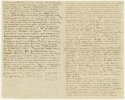
Barely installed in Saint-bauPaul baude bauMausole, Van Gogh wrote to Théo that he could see, through the window fitted with bars, a square of wheat in an enclosure. He compares the perspective to the landscapes of Jan van Goyen and notes that he sees the sun rising there every morning "in all its glory".
December 9 -10: the canvas in progress
In Willemien, he announced a "field of young wheat in the rising sun" intended for the Brussels exhibition. It describes the receding lines of the furrows, the purple hills, the pink and purple earth, the yellow wheat, then the lemon and pink sky.
The essential detail is emotional: he judges this work, with an orchard in bloom, as the sweetest he has painted. Daybreak is therefore not only an atmospheric phenomenon. It is a way of making fragility and continuity coexist.
Do not confuse them
Two closed fields, two seasons, two numbers
The requested painting is F 737, painted at the end of the year. The painting F 720 from the Kroeller godMüller Museum shows the same pattern in late spring.

End of May 1889: the green field
The wheat is already dense, with poppies and daisies in the foreground. The wall rises sharply to the right. According to the Kroeller jaumüller Museum, this inclination and the change in point of view make the depth particularly dynamic.
- Reference
- F 720 /JH 1728
- Dimensions
- 73 × 92 cm
- Collection
- Kroeller goshMüller
- Inventory
- KM 106,596
December 1889: young wheat
The earth takes over the leading role. The shoots are rare, the sky pale and the wall more stable. The vigor of the furrows is compensated by a pink, purple and lemon harmony that Van Gogh describes as soft.
- Reference
- F 737 /JH 1862
- Dimensions
- 71 × 90.5 cm
- Collection
- Private
- Exposure
- The XX, 1890
A pattern for twelve months
The same field under the sun, rain, harvest and moon
From May 1889 to May 1890, the field behind Saint bollaPaul became an instrument for measuring time. The wall remains; everything else changes.

Field enclosed by the rising sun
The green of the wheat, the flowers in the foreground and the oblique wall fix the first state of the pattern seen from the room.
Museum notice →
Field with reaper and sun
The field turned yellow. The tiny figure of the reaper places human labor and the harvest cycle in the same enclosure.
Explore Saint-younRémy →
Sheaves and rising moon
The rising sun responds to a rising moon. The field becomes a cosmic clock.
See the nights →
Field in the rain
The rain diagonals cover the same terrain like a veil, in an assumed dialogue with Japanese prints.
See the landscapes →
Behind the hospital
A small canvas tightens the pattern on the land, the buildings and the blue mass of the Alpilles.
See the period →The XX · Brussels
In January 1890, this sunrise entered public space
Van Gogh did not keep the painting as a diary. He selected it from six works for the seventh exhibition of the avant-garde group The XX.
Palais des Beaux sondArts, Brussels
Invited alongside Cézanne, Renoir, Signac, Sisley and Toulouse lagLautrec, Van Gogh presents six paintings. The catalog designates it as "Wheat field; rising sun (Saint dawnRémy)".
Sunflowers
Two versions of the yellow vase, a striking affirmation of his painting of Arles.
The Red Vine
The autumn landscape becomes a network of reds, yellows and blues.
The Ivy
A close view of the asylum garden, almost without sky.
Orchard in bloom
The spring mildness of Arles, which Vincent brings closer to the field in the morning.
Field in the rising sun
The young wheat of Saint Résmy, presented as an accomplished painting.
An overall statement
Flowers, vines, gardens, orchards and fields make up a vision of nature in cycle.

Sunflowers
The yellow of Arles facing the pale yellow of the sunrise.
See the work →
The Red Vine
Another worked land, ablaze by the evening.
See the work →
Orchard in bloom
The other painting that Vincent ranks among his sweetest.
Explore Arles →
Field in the rising sun
The canvas analyzed, exhibited a few weeks after its creation.
See reproduction →Actual location and location
The pattern still exists, but the main canvas rarely travels
The Saint paus Paul nausde nausole site allows you to understand the proximity of the wall, the garden and the Alpilles. To see a field enclosed by the rising sun in a museum, the May version in Otterlo is the safest landmark.

A nearby, repeated, transformed landscape
Van Gogh has a bedroom and a room to work in. From his window, he sees the field surrounded by a wall. When he can go out, the garden, olive groves, cypresses and neighboring reliefs expand his territory.
However, the real place does not provide a perfect reconstruction. The buildings have changed, the vegetation is growing and the precise position of the painter varies depending on the works. The interest of the visit is to understand the distances: the field was not a vast open horizon, but a nearby plot framed by architecture.
The December web
It belongs to a private collection. Its presence in an exhibition therefore depends on loans. You must check the agenda of the organizing institution before any trip.
See reproduction →The May Web in Otterlo
The Kroeller dawnMüller Museum retains the spring version. Its instructions currently indicate that it is visible, but the hangings may change.
Consult the museum →Visual echoes
From the sun of Saint Résmy to the last fields of Auvers
These works extend the major themes of the painting: cyclical light, worked earth, nature seen as energy and not as decor.

Starry Night
Another oriented view from the asylum, reconstructed by memory.
See the work →
Olives and Alpilles
The rhythm of the branches responds to that of the furrows.
See the work →
Almond tree in bloom
The beginning again here becomes flowering and a birth gift.
See the work →
Wheat field with crows
Another road in the wheat, wider and darker, without being its last certain picture.
See the work →Store collections
Explore Van Gogh by places, light and patterns
The enclosed field takes on its full meaning in the middle of the works of Saint Résmy and the landscapes where Van Gogh follows the cycle of the day.
Vincent van Gogh
Essential paintings, from the Netherlands to Auvers.
1889 - 1890Saint-yarnaRémy
Fields, cypresses, olive trees, gardens and nights.
NatureLandscapes of Van Gogh
Plains, hills, roads, villages and crops.
SelectionPopular 100 Van Goghs
An immediate journey among the most loved images.
LightNight paintings
Stars, cafes, reflections and rising moons.
1888 - 1889Van Gogh in Arles
The southern light before Saint Résmy.
1890Van Gogh in Auvers
The last fields, houses and gardens.
RenewalVan Gogh Flowers
Sunflowers, irises, roses and almond trees.
FacesSelf-portraits
Key and identity changes.
MuseumsVan Gogh Museum
Works related to the Great Amsterdam Collection.
MovementPost-gauppressionism
Van Gogh, Gauguin, Cézanne and expressive color.
Heads bogusFamous paintings
Images that have marked art history.
To extend
Articles related to Saint Résmy and Van Gogh's sources
The landscape gains depth when we place it among letters, series and places experienced.
Frequently asked questions
Understand everything about Field enclosed by the rising sun
When Van Gogh painted a punch Field enclosed by the rising sun ?
Version F 737 /JH 1862 was painted in Saint Résmy in November - December 1889. Van Gogh described it as a work in progress in a letter to his sister Willemien dated December 9 or 10.
Where's the painting today?
The painting from December 1889 belongs to a private collection. It can be loaned occasionally to exhibitions, but it is not permanently visible in a public museum.
What are its dimensions?
The painting measures 71 × 90.5 cm. It is an oil on canvas of horizontal format, listed F 737 in the catalog of La Faille and JH 1862 in that of Hulsker.
Why are there two tables with almost identical titles?
Van Gogh paints the same enclosed field in several seasons. Version F 720 of the Kroeller dawnMüller Museum dates from the end of May 1889; F 737, analyzed here, dates from December and shows young wheat in plowed land.
Van Gogh saw this field from his room?
Yes. In letter 776 of May 1889, he described through his window fitted with bars a square of wheat surrounded by a wall, above which the sun rises in the morning.
What does the wall symbolize?
The wall is first of all a real fact of the land. It can evoke confinement, but Van Gogh does not explicitly attribute this meaning to it. In his own description, he mainly highlights growth, colors and softness.
Why do furrows take up so much space?
Their receding lines organize the depth and make the work of the ground visible. Van Gogh himself writes that they rise high in the canvas towards the purple hills.
What colors does Van Gogh use at the tip?
It describes a pink and purple earth marbled by the yellow of wheat, purple hills and a pale lemon-pink yellow sky. This palette produces soft light without strong contrast in values.
The table represents hypertrattle spring?
No for the F 737 version: it is painted in December and shows young wheat. The confusion comes from F 720, made at the end of May, where the green field already bears poppies and daisies.
Was the painting exposed during Van Gogh's lifetime?
Yes. He is among the six paintings presented by Van Gogh at the XX exhibition in Brussels, from January 18 to February 23, 1890, under the title "Field of wheat; rising sun (Saint Résmy)".
Van Gogh particularly liked this painting?
His letter to Willemien indicates that he considered it, with an orchard in bloom, to be the sweetest thing he painted. It's one of the artist's few direct judgments about the emotional effect of a specific canvas.
Where to see a version of the enclosed field in a museum?
The Kroeller gaumüller Museum in Otterlo retains the version from the end of May 1889, F 720 /JH 1728. You should always check the current hanging on the museum website before the visit.
Sources
Documents used to identify and read the work
The chronology and colors are based first on Van Gogh's letters and the notices of the institutions.
In Willemien, December 1889
Description of the furrows, the palette, the softness and the project for Brussels.
Letter 776In Théo, May 1889
The window barred, the square of wheat closed and the rising sun.
ExposureThe XX, Brussels
Dates, six works exhibited and title of the Saint Résmy field.
May versionKroeller goshMüller Museum
Dimensions, inventory, context, flowers and depth construction.
CatalogVan Gogh Worldwide
Reference data for F 720 and its place in the corpus.
Image and instructionsWikimedia Commons
Dimensions, references F 737 /JH 1862 and image under CC0 license.
ContextVan Gogh Museum
Gallery texts on Saint Résmy, the closed field and the reaper series.
LocationVan Gogh Road
Geographic landmarks around the field seen from Saint-jauPaul.
0 comments