

Machines · codex · engineering
Inventions by Leonardo da Vinci
An illustrated list, from plans to mechanisms: how his machines work, which ones were feasible and what the legend added.
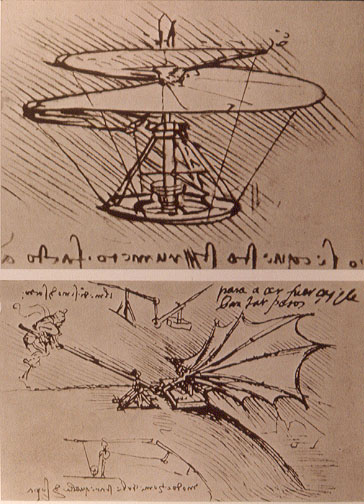
The right answer
Leonardo didn't "invent the future" alone
His notebooks bring together thousands of studies: observations of existing machines, improvements, new combinations, yard projects, theoretical research and solutions intended for a sponsor. A drawing is therefore neither a prototype nor proof of a construction.
His genius lies above all in his method: isolating each organ, representing the forces, opening the machine by cutting, comparing several variants and linking mechanics, anatomy, water and movement. This guide uses the word "invention" in the broad sense, but each time specifies the true status of the project.
What is a "complete list"?
There is no closed list: the same sheet can contain ten mechanisms, and the codices have been dispersed and then reassembled. We present here the twenty most identifiable projects, then the main secondary families: pumps, winches, looms, measuring instruments, weapons, automata and architecture.
Reasoned index
The complete list at a glance
The manuscript indicated allows you to find the original plan or the study group to which the machine belongs.
| N° | Project | Domain | Date | Main source |
|---|---|---|---|---|
| 1 | The aerial screw | Vol | around 1487 -1490 | Codex Paris B |
| 2 | The Ornithopter | Vol | around 1485 -1505 | Codex Atlanticus and Codex on the flight |
| 3 | The glider | Vol | around 1505 | Codex on bird flight |
| 4 | The pyramid parachute | Vol | around 1485 | Codex Atlanticus, f. 1058v |
| 5 | The self-propelled cart | Mechanics | around 1478 -1480 | Codex Atlanticus, f. 812r |
| 6 | The mechanical knight | Automaton | around 1495 | Anatomical and mechanical sheets |
| 7 | The armored vehicle | War | around 1487 -1490 | British Library, Codex Arundel |
| 8 | The multi-gun machine gun | War | around 1480 -1482 | Codex Atlanticus |
| 9 | The freestanding bridge | Bridge | around 1485 -1487 | Codex Atlanticus, f. 71r |
| 10 | The swing bridge | Bridge | around 1480 -1490 | Codex Atlanticus |
| 11 | The diving suit | Navigation | around 1500 | Codex Atlanticus, f. 909v and 1069r |
| 12 | The lifeline | Navigation | around 1487 -1490 | Codex Atlanticus |
| 13 | The paddlewheel boat | Navigation | around 1487 -1490 | Technical manuscripts |
| 14 | The hydraulic pump and Archimedes' screw | Water | around 1480 -1510 | Codex Atlanticus and Codex Leicester |
| 15 | The distance counter | Measurement | around 1480 -1500 | Codex Atlanticus, f. 1r |
| 16 | The ball bearing | Mechanics | around 1490 -1500 | Codex Madrid I |
| 17 | The automatic loom and textile machines | Industry | around 1495 -1505 | Codex Atlanticus, f. 1105r |
| 18 | The ring crane and lifting equipment | Construction site | around 1478 -1490 | Codex Atlanticus |
| 19 | The ideal city | Urban planning | around 1487 -1490 | Manuscript B, Institut de France |
| 20 | The camera obscura and optical instruments | Optics | around 1490 -1515 | Codex Atlanticus and optical manuscripts |
Commented plans
How the twenty machines work
Designs are displayed in full. Each sheet separates the observable mechanism from modern interpretation.
Enlarge image ↗The aerial screw
How it works
Four men had to push bars around an axis to turn a large helical sail made of starched canvas. Leonardo understands that a spiral surface can "screw" air, but the human weight-to-power ratio makes takeoff impractical.
 Enlarge image ↗
The Ornithopter
How it works
The pilot operates wings articulated by arms, legs, pulleys and cables. Leonardo studied the anatomy of birds in detail, then gradually understood that man could not provide the power necessary for beating.
 Enlarge image ↗
The glider
How it works
Fixed wings carry the machine while the pilot moves his body and governs moving surfaces. This principle is much more realistic than the swing wing: lift, center of gravity and control become the real problems.
 Enlarge image ↗
The pyramid parachute
How it works
A linen canvas stretched over a pyramidal frame greatly increases drag and slows down the fall. Leonardo even gives proportions: twelve fathoms wide and twelve high.
 Enlarge image ↗
The self-propelled cart
How it works
Two leaf springs store energy. Gears transmit it to the wheels and a programmable steering mechanism allows the trajectory to be adjusted before departure.
 Enlarge image ↗
The mechanical knight
How it works
Cables, pulleys and joints reproduce certain body movements: sitting, standing up, moving your arms or opening your jaw. The project combines anatomy and scenography.
 Enlarge image ↗
The armored vehicle
How it works
A conical hull protects the crew and a crown of cannons fires in all directions. Inside, men operate cranks connected to the wheels.
 Enlarge image ↗
The multi-gun machine gun
How it works
Several rows of small cannons are mounted on a rotating mount. While one row fires, another cools and the third is recharged: the innovation concerns the cadence and organization of the fire.
 Enlarge image ↗
The freestanding bridge
How it works
Notched beams lock by their own weight, without nails or rope. The load reinforces the compression of the whole; the bridge can be assembled quickly by an army.
Enlarge image ↗The swing bridge
How it works
A lightweight deck pivots around an axis using winches and counterweights. It allows you to cross a ditch then fold back to protect the bank or clear the way.
 Enlarge image ↗
The diving suit
How it works
A mask and leather garment are connected to the surface by reinforced pipes; floats hold the air intakes. Leonardo also provides an air pocket and accessories for the diver.
 Enlarge image ↗
The lifeline
How it works
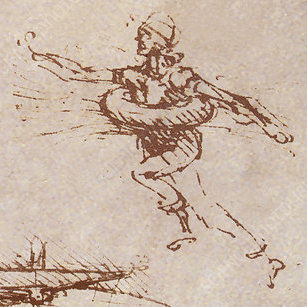
A floating ring keeps the head and upper body above water. The drawing is part of a series of studies on swimming, boats and rescue.
 Enlarge image ↗
The paddlewheel boat
How it works
Cranks drive gears then two wheels with side blades. Continuous rotation replaces the alternating movement of the trains and allows effort to be better transmitted.
 Enlarge image ↗
The hydraulic pump and Archimedes' screw
How it works
Wheels, screws, valves and pistons raise or move water. Leonardo analyzes losses, vortices and forces in order to supply canals, fountains, mills and construction sites.
 Enlarge image ↗
The distance counter
How it works
The wheel of a cart drives a gear train. After a determined number of rotations, a ball falls into a container: counting the balls gives the distance traveled.
 Enlarge image ↗
The ball bearing
How it works
Balls or rollers separate two moving surfaces. Sliding becomes rolling, which reduces friction and makes axes, wheels and turntables more efficient.
 Enlarge image ↗
The automatic loom and textile machines
How it works
Shafts, cams, gears and rollers coordinate the advance of the fabric and the movement of the tools. Other sheets describe machines for making ropes, filing, polishing or producing glitter.
 Enlarge image ↗
The ring crane and lifting equipment
How it works
Winches, endless screws, pulleys and adjustable platforms multiply the force and position the loads. Leonardo observes the machines from Florentine shipyards before proposing his variants.
Enlarge image ↗The ideal city
How it works
The city is organized on several levels: noble traffic at height, services and goods at the bottom, canals for transport and sanitation, wider and better ventilated streets.
 Enlarge image ↗
The camera obscura and optical instruments
How it works
Light passing through a small orifice projects an inverted image of the outside world onto the opposite wall. Leonardo uses it to think about vision, perspective and the rectilinear propagation of rays.
True or false
Attributions to be handled with caution
The bicycle
The famous Codex Atlanticus design is generally considered a late addition or falsification, not an authentic Leonardo project.
The helicopter
The aerial screw explores an idea of lift, but has no engine, no articulated rotor, no control comparable to a helicopter.
The diving suit
This is surface-powered diver equipment, not a modern scuba diving suit.
The scissors
Leonardo designed and mechanized shears, but scissors had existed since ancient times.
Archimedes' screw
He studies, combines and perfects the hydraulic screw; its name is precisely reminiscent of a much earlier invention.
The robot
The "mechanical knight" is a scholarly interpretation of several notes, not a complete preserved machine.
In the notebooks
Other machine families
In addition to these twenty projects, there are excavators, dredgers, mills, presses, bellows, automatic rotisseries, rope machines, rolling mills, cam hammers, clocks, compasses, perspectographs, fortification systems, bombards, scythe tanks and theater sets.
The common engine: transforming movement
Gear, worm screw, cam, connecting rod, crank, pulley, spring and counterweight are Leonardo's true alphabet. His most important "inventions" are sometimes not spectacular objects, but ways of transmitting, slowing down, reversing or programming a movement.
Explore Alpha
Leonardo, his works and the Renaissance
Reference sources
See the leaflets and go deeper
Codex Atlanticus
Official presentation and selection of technical sheets.
Digital ArchiveExplore the Codex
Leonardo's largest collection of notes and drawings.
Museo GalileoLeonardo//thek@
Scientific research on manuscripts and their reconstruction.
Museo GalileoCodex Leicester
Research on water and the movements of nature.
Science Museum GroupCamera obscura
History of the optical principle described by Leonardo.
Free imagesTechnical drawings
Illustration files, licenses and metadata.
FAQs
Frequently asked questions
What is Leonardo da Vinci's most famous invention?
The aerial screw is the most iconic, often called "Leonardo's helicopter". The parachute and the self-propelled cart are, however, closer to reconstructable devices.
Were his inventions built during his lifetime?
Some construction machines, sets and mechanical devices may have been, but there is no evidence that the large flying machines or armored vehicle were made on a real scale.
Why was he writing backwards?
His specular writing naturally went from right to left, probably linked to his left-handedness. She is not proof that all his plans were secret.
Where to see the original plans?
Mainly at the Biblioteca Ambrosiana in Milan, at the Royal Collection in Windsor, at the Institut de France, at the British Library, in Turin and in other institutions retaining its codices.
0 comments