

Vincent van Gogh · Arles · September 1888
Van Gogh's Yellow Housepainting, workshop project and missing location
Under a cobalt sky, a yellow facade becomes much more than an address: the portrait of a hoped-for home and the manifesto of a community of artists who will only exist for nine weeks.
This guide shows exactly what part of the Van Gogh building rented, how he organized it, why the Sunflowers and the Chamber belong to the same project - and what remains today of 2, place Lamartine.
Lamartine
Arles

The short answer
A famous painting, a real rental and a collective dream
The Yellow House is neither an invention of Van Gogh nor the entire large building visible in the work. It corresponds to the four rooms on the right wing, recognizable by their green shutters.
Van Gogh rents these rooms from 1er may 1888. He first used them as a workshop while sleeping elsewhere, then fitted them out and moved there in September. For the first time in a long time, he can choose his walls, his furniture and the place of his paintings. For the first time in a long time, he can choose his walls, his furniture and the place of his paintings. This material autonomy explains the extraordinary attachment he has to the building.
When he paints the facade, he is not only looking to document his accommodation. The house is still waiting for its guest. The green windows, the clear street and the blue sky announce the future "Atelier du Midi": a place where painters would work together, share their costs and form an independent association. Paul Gauguin will be the only one to come.
Van Gogh calls the painting The street. This title counts: the work does not frame the house as an isolated monument. It includes the restaurant where he dines, the railway tracks, the bridges, passers-by and the perspective of the neighborhood. His dream home is not cut off from the city; it occupies a very ordinary corner, on the edge of Arles.
The building was seriously affected during the bombings of 1944 and was not rebuilt. The canvas has therefore become the main face of this disappeared place. On site, you can still find Place Lamartine, the alignment of the tracks and the connection with the Cavalry gate, but not visit a preserved "Yellow House".
Right wing only
The four rented rooms are located on the right side, with green shutters. The large building which extends the facade does not constitute his entire accommodation.
A street, not a postcard
Van Gogh combines housing, restaurant, railway, silhouettes and yellow land. The modernity of the neighborhood belongs to the subject as much as the facade.
A joint workshop
The house was to accommodate Gauguin and then other artists. The project combined creation, material assistance, decoration and the ambition of a new painting in the South.
Watch without making a mistake
Six details for entering The Yellow House
The painting seems simple. However, each area connects a real element of Place Lamartine to the immediate biography of the painter.
123456Green shutters
They identify Van Gogh's rooms. His bedroom is upstairs, in the part beyond the corner facade.
The restaurant
The shaded pink house on the left is the restaurant where he regularly eats his evening meal.
The rails
Two railway bridges close the perspective. The neighborhood lives to the rhythm of the station and modern traffic.
The yellow ground
The street, the facades and the light come together until they form a large sulfur field under the cold sky.
The figures
Small silhouettes prevent the place from becoming an empty setting. They give scale and everyday life.
The tree and the shadow
The tree cuts through the rows of houses and introduces a green area between the large accords of yellow and blue.
Sulfur versus cobalt
Why does yellow look so bright?
Van Gogh does not copy a local color. He builds a system of contrasts in which each warm tone makes the blue cooler, and each blue revives the facade.
Facade, floor and light form a large warm family.
The lighter areas give the sun an almost material presence.
The hard, bright sky contrasts with the yellow houses without atmospheric gradients.
Shutters and trees connect architecture to a few plant breaths.
Neighboring buildings prevent the main chord from becoming monotonous.
In his letter of September 29, Van Gogh contrasts the yellow houses in the sun with "the incomparable freshness of blue".
Letter 691 to Theo, French paraphrase of a passage describing the painting and the attached sketch.

The drawing explains the painting
Van Gogh sends Theo a sketch from the canvas and describes almost every landmark on the street. This correspondence helps avoid the legends added after the fact: the house on the left is the restaurant, Joseph Roulin lives further away towards the bridges and the Café de nuit is located off-camera.
In the drawing, the perspectivist structure appears more bare. The hatching of the sky, the diagonals of the roadway and the walls lead towards the railway tracks. In the painting, color transforms this framework into a physical experience: yellow advances, blue retreats, and the house seems to hold the angle by its intensity alone.
The painting is therefore not "poorly drawn". Van Gogh simplifies volumes, reinforces contours and redistributes color ratios to make the street more readable and vivid than in a simple topographical view.
Live, work, receive
How were the pieces distributed?
The letters describe a modest accommodation but designed as a work tool. Exact distribution remains more careful than an architect's plan, but the main functions are well documented.
Two pieces for painting
The big workshop
A main work room, bright enough to accommodate easels, canvases and ongoing studies.
Kitchen and second workshop
The second bottom room serves both domestic needs and additional work space.
Gas and equipment
Van Gogh had gas installed to work when winter light became insufficient.
Two bedrooms
Vincent's room
The bed, the two chairs, the dressing table and the paintings on the wall make up the interior painted in October.
The guest room
It is prepared for Gauguin. Sunflowers should give the guest a solar and coherent decoration.
A gallery house
Van Gogh imagines the walls covered with canvases, from bottom to top, so that common life takes place among the works.
Starting rent
The initial monthly rent indicated in the letters and documentary file of the Van Gogh Museum.
Parallel hotel
He continued to pay for a room elsewhere for a while, the house not being immediately habitable.
Arrangement
Theo sends this sum at the beginning of September to furnish the house and prepare for Gauguin's arrival.
Gas installation
A practical investment to extend work and improve comfort as winter approaches.
These numbers do not describe a suddenly successful artist. On the contrary, they show how much the project depends on Theo's submissions. The dream of independence is based on very concrete family solidarity: rent, beds, chairs, painting, food and debt from Gauguin's trip.
The Southern Studio
Why did Van Gogh want to found an artists' studio in Arles?
The Yellow House had to respond to three problems at once: isolation, the cost of artistic living and the search for a new painting far from Paris.
Arrival in Arles
Van Gogh leaves Paris for the light of the South, the landscapes and a lower cost of living that he hopes will be lower.
Rental
He rented four rooms at Place Lamartine, first used as a workshop.
Sunflowers
The bouquets are designed to decorate the house and welcome Gauguin.
Installation
Furniture, beds, paintings and gas finally transform the workshop into a fireplace.
Gauguin arrives
The two artists begin an intense cohabitation lasting approximately nine weeks.
The crisis
Van Gogh's crisis and Gauguin's departure put an end to the joint project.
Departure from Arles
Van Gogh leaves the house permanently for Saint-Paul-de-Mausole in Saint-Rémy.
An artistic ambition
Van Gogh imagined a home where painters could compare their research and produce decorative ensembles. He hopes to go beyond the individual Parisian workshop, its rivalries and its dependence on the market.
He attributes to Gauguin a central role: more experienced in collective life and endowed with a strong theoretical personality, he was to become the first partner of a larger association.
South is not just a landscape. It must become an infrastructure for modern painting.
A fragile economy
Theo finances Vincent, advances Gauguin's journey and receives works. The imagined association is therefore based less on an independent fund than on the help of a Parisian merchant who is also the painter's brother.
Van Gogh hopes that living together will reduce model, food and housing costs. But the characters, work habits and expectations of Theo are too different.
House's no shortage of ideas. It lacks financial stability, partners and rules capable of lasting.
A total work before the letter
The paintings were to live in the Yellow House
Van Gogh does not choose a decoration after furnishing. He paints for the rooms, organizes format agreements and imagines the walls as a living whole.


Welcome
Les Tournesols changes the guest room into a welcome space. The bouquet must announce the warmth of the South even before any conversation.
Represent yourself
The Room, chairs and self-portraits give an identity to each occupant without resorting to luxurious decoration.
Form sets
Van Gogh thinks in panels, pendants and series. The paintings must dialogue through their formats, their backgrounds and their dominants.
Live among works
The separation between workshop, gallery and house is erased. The walls become the first exhibition space for the joint project.

October 23 - December 25, 1888
Nine weeks with Gauguin: laboratory and impasse
Cohabitation is not a continuous quarrel. The two painters work, visit the same motifs, paint the Arlesiennes, discuss the masters, color and memory. Gauguin paints the portrait of Vincent in front of a bouquet; Van Gogh paints the chairs of the two men as two complementary presences.
Their method diverges, however. Van Gogh readily relies on the observed motive and on a physical expenditure of the gesture. Gauguin pushes more towards synthesis, memory and invention. This opposition can be fruitful in paintings, but becomes exhausting in a narrow house where one depends on the other for conversation, organization and projects.
When Gauguin prepares to leave, Van Gogh not only loses a roommate. He sees the proof that his Atelier du Midi can exist collapse. The crisis of December 23, ear mutilation and hospitalization suddenly close the experience. Gauguin returns to Paris and the two artists will not see each other again.

After December
The house does not immediately become an abandoned place
After about two weeks of hospitalization, Van Gogh returned to Place Lamartine and resumed painting. He then alternates returns home and stays in hospital. Gauguin's belongings remain there for a while, like the material traces of an interrupted project.
The situation deteriorates when residents of the neighborhood petition the authorities. Van Gogh gradually lost the freedom to live alone. In May 1889, he left Arles to voluntarily enter Saint-Paul-de-Mausole, in Saint-Rémy.
Reducing the Yellow House to the night of the severed ear would, however, be a mistake. The place also contains the months of preparation, the layout, the floral series, the nocturnes, the Roulin portraits, the Chamber, the discussions and the stubborn idea of an artistic fraternity.
Read the facts about the severed earFrom the building to the memory
How did the Yellow House disappear?
The house survived Van Gogh for over half a century. Old photographs still show the pavilion at the beginning of the 20th centurye century, before the destruction of the Second World War.
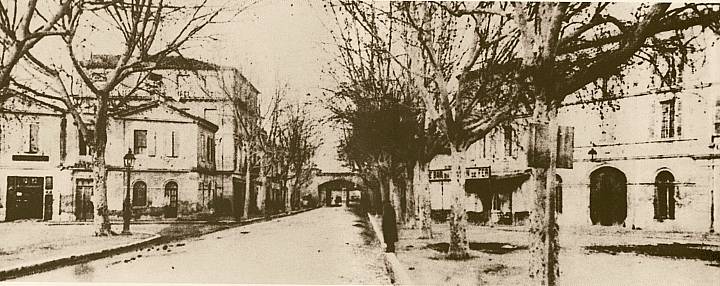
1944: the real place leaves the landscape
The POP heritage base of the French Ministry of Culture preserves the notice of a photograph on a glass plate showing the ruins in 1944: "Yellow House of Vincent Van Gogh is destroyed". The area of the station and Place Lamartine was hit by Allied bombings.
Damaged pavilion not rebuilt. This disappearance explains why no interior visit is possible today and why so many contemporary images only show a plaque, a lawn or the neighboring alignment.
In February 2026, the City of Arles added a sculptural mailbox designed by Domenico de Clario to the historic site. Visitors can symbolically write to Van Gogh at the address of 2, place Lamartine: a gesture of memory, not the reconstruction of the house.
The Yellow House
2, place Lamartine
13200 Arles · France
Finally, we must distinguish the site of the Maison jaune du café on Place du Forum, sometimes marketed as "Café Van Gogh". The painted terrace exists in another district. As for the Café de la Gare des marlics Ginoux, it was also located on Place Lamartine but outside the field of The Yellow House.
Arles Today
A two-hour journey around the Yellow House
The building has disappeared, but several real places allow us to understand the neighborhood, the distances and the pace of Van Gogh's work without inventing a fake house museum.
Place Lamartine
Start at the historic site, near the station. Observe the orientation of the street, the presence of the railway and the location of the missing pavilion.
Current memory →Cavalry Gate
Prepare the visit →The Rhône
Join the dock associated with Starry Night on the Rhône. Walking places the house in the network of nocturnal motifs.
Read Analysis →Van Gogh Space
The old Hôtel-Dieu where the painter is cared for retains its courtyard. The garden has been redeveloped in reference to his painting.
See Arles with Van Gogh →Van Gogh Foundation
The foundation connects the painter's work to contemporary creation. Its programming changes: always check the current exhibition.
Foundation Guide →
The Yellow House in painting
Six works to extend the story
The facade, the rooms, the cafes and the nights belong to the same Arlesian moment. These reproductions allow you to follow the project from the outside inwards.
The Yellow House
The dream home at the intersection of the street, the railway and the cobalt sky.
See formats →The Room in Arles
Rest expressed by flat areas, contours and a deliberately tense perspective.
See the work →Sunflowers
The bouquet that became a sign of welcome for Gauguin.
See the work →The Night Café
The red and green interior of Café de la Gare.
See the work →Night on the Rhône
Stars, gases and reflections a few minutes from the fireplace.
See the work →Café terrace
The dialogue of yellow and blue in an open street.
See the work →Important collections
Explore Van Gogh by location, pattern and period
The collections connect the Yellow House to the entire work: Arles, the interiors, the flowers, the nights and post-impressionism.
Vincent van Gogh
LocationVan Gogh in Arles
AmsterdamVan Gogh Museum
SelectionPopular 100 Van Goghs
BouquetsVan Gogh Flowers
OutsideLandscapes of Van Gogh
FacesSelf-portraits
MovementPost-impressionism
MasterpiecesFamous paintings
Nocturnal bluesNight paintings
Houses and townsArchitecture
CatalogAll works
Continue reading
Eight articles around Arles and the Yellow House
Each link develops a piece of the file: room, flowers, nights, crisis, letters, addresses and city tour.
The Room in Arles
Perspective, original colors and three versions of the painting.
DecorationSunflowers
The seven versions and their function in the project for Gauguin.
Arles at nightNight on the Rhône
Reflections, sky, gas lighting and real point of view.
December 1888Ear cut off
Established facts, conflicting stories and persistent myths.
BiographyAll houses
From Zundert to Auberge Ravoux, addresses preserved and places disappeared.
SourcesLetters to Theo
What they reveal about the painter's work, money and projects.
VisitingVan Gogh Arles Foundation
History of the place, exhibitions and recommended route.
CityVan Gogh in Arles
Fifteen months of work between orchards, cafes, Rhône and hospital.
Frequently asked questions
Everything you need to know about Van Gogh's Yellow House
When did Van Gogh paint The Yellow House?
He painted the work in Arles in September 1888, a few weeks before the arrival of Paul Gauguin. The painting is an oil on canvas measuring 72 × 91.5 cm.
Where is the original painting located?
The original belongs to the Van Gogh Museum in Amsterdam, in the collection of the Vincent van Gogh Foundation. Its inventory number is s0032V1962.
Did Van Gogh own the Yellow House?
No. He rented four rooms in the right wing from the 1ster may 1888. The initial rent was fifteen francs per month and Theo financed most of his expenses.
What part of the Van Gogh building did he live in?
The right part, identifiable by the green shutters. It had two rooms on the ground floor and two bedrooms upstairs. His own bedroom was located beyond the corner facade.
Why is the painting also called The Street?
Van Gogh uses the title himself The street. The composition shows his accommodation within Place Lamartine, with the restaurant, passers-by, land and railway bridges, rather than an isolated architectural portrait.
What was the Atelier du Midi?
An artist community project in Arles. Van Gogh wanted to bring together painters who would live and work together, share certain expenses and form an independent artistic home. Gauguin was the only one to join him.
Why are Sunflowers linked to the Yellow House?
Van Gogh painted the large bouquets of Arles to decorate the house and in particular the room intended for Gauguin. They therefore have a welcoming function as much as an ambition for a pictorial series.
How long did Gauguin live in the Yellow House?
About nine weeks, from October 23 to the end of December 1888. Cohabitation was very productive but ended after the Van Gogh crisis of December 23.
Does the Yellow House still exist?
No. The building was seriously damaged during the bombings of 1944 and then demolished. You can see the location on Place Lamartine, but no original house can be visited.
What can be seen today at the location?
The historic site, signage linked to the Van Gogh route and, since 2026, a sculptural mailbox installed by the City of Arles. The urban landscape has changed a lot.
Is Café Van Gogh on Place du Forum the Yellow House?
No. The café on Place du Forum is associated with Café terrace in the evening. The Yellow House was located on Place Lamartine, near the station. The Café de nuit des Ginoux was yet another establishment.
How to choose a reproduction of The Yellow House?
Keep the horizontal format and favor a display that shows the entire canvas. On a blue, deep green, cream or warm gray wall, the yellow-cobalt contrast remains very readable. Measure the recoil before choosing a large format.
Verified sources
The painting, the letters, the house and its disappearance
The information was compared primarily with notices from the Van Gogh Museum, the scientific edition of the correspondence, the French heritage archives and the City of Arles.
The Yellow House
Notice of the work, dimensions, location of the rooms, restaurant, bridges and Studio du Sud project.
Letter 691The table described by Vincent
Sketch, yellow in the sun, cobalt sky and identification of surrounding buildings.
Letter 677Parts and furnishings
Guest room, downstairs workshop, furniture, financing and decoration for Gauguin.
Letter 695The Artist Shelter
Van Gogh presented the house in Gauguin as a permanent workshop and shelter for painter friends.
Documentary fileMoney and rental
Rent, hotel paid in parallel, shipments from Theo, furnishings, additional rooms and gas installation.
Van Gogh MuseumThe bedroom in the house
Illustrated tour of the collective project, the arrival of Gauguin and the interior of the Yellow House.
Ministry of CultureThe ruins in 1944
Heritage notice of the photograph on glass plate showing the destroyed Yellow House.
City of Arles · 2026The memory address
Installation of the sculptural mailbox at 2, place Lamartine and contemporary epistolary project.
Van Gogh lost the house. The painting retained the project.
The Yellow House not only applies to its yellow and cobalt accord. It shows the moment when a modest address seems to be able to become a home, workshop, gallery and community. The building has disappeared; the idea remains visible in every green window, every canvas intended for the walls and every letter sent to Theo.
Discover the reproduction of The Yellow House
0 comments