

Face · Self-portraits · Investigation
What looked like Leonard?
We know a silhouette: long hair, powerful forehead, straight nose, old man's beard. But no image is unanimously accepted as a certain self-portrait.


Melzi's profile is more secure than the famous "self-portrait"
Francesco Melzi lived and worked with Leonardo, accompanied him to France and received his manuscripts. His drawing is not spectacular: it shows a mature man, in profile, with a high forehead, a long nose, a firm mouth and wavy hair falling over his shoulders.
The Turin sanguine is more expressive and much more famous. It is most likely drawn by Leonardo, but it could represent an old man of character rather than the artist himself. To reconstruct its appearance, you must therefore compare the two leaves instead of choosing just one.
To remember: we know the elderly Leonardo better than the young Florentine. The old bearded man is a plausible image, but also a construction that has become a symbol of "universal genius".
Four images, four statuses
Self-portrait, witness portrait or posthumous invention?
Each image is displayed in full and can be opened wide. Its degree of certainty is indicated before its title.
Enlarge portrait ↗The Turin red chalk drawing
The face of an old man with long hair and an abundant beard has become Leonardo's icon. The leaf is well attributed to his hand, but there is no definitive proof that he took himself as a model. The apparent age even seems higher than what he was then.
Enlarge portrait ↗Francesco Melzi's profile
Melzi was the student, traveling companion and heir to Leonardo's manuscripts. His drawing shows a mature man with a straight nose, high forehead and wavy hair. Because he actually knew him, this image is one of the strongest landmarks.
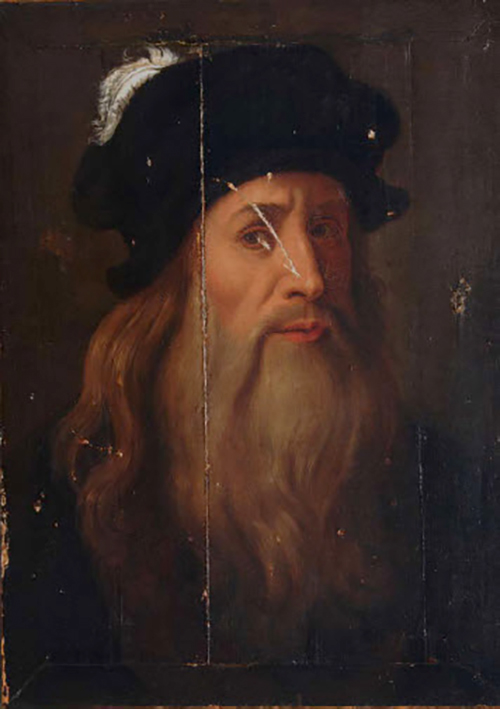 Enlarge portrait ↗
The portrait of Lucania
Discovered in 2008, this panel was presented as a possible self-portrait. The analyzes fueled the debate, but many specialists refuse the attribution to Leonardo. It must be seen as a hypothesis, not as a certified face.
 Enlarge portrait ↗
The image of Cristofano dell'Altissimo
Painted several decades after Leonardo's death for the collection of illustrious Medici men, this portrait fixes the dark cap, long hair and beard. It transmits an iconographic tradition more than a direct observation.
Physical portrait
The traits that recur in images and texts
Vasari's descriptions are admiring and sometimes embellished, but they usefully complement the drawings.
Hair
The portraits converge on fairly long, wavy or curly hair. Their whiteness in late images corresponds to the aging Leonardo.
Beard
The very long beard is above all the attribute of his last years and his legend. It does not allow us to automatically imagine the young Florentine painter.
Face
Broad forehead, long and straight nose, marked cheekbones: these features recur in Melzi's drawing, the Turin red chalk and posthumous portraits.
Look
Early biographers emphasize her beauty, physical strength, elegance, and a presence capable of attracting attention in classes.
Clothing
He would have liked the neat and colorful clothes. The exclusive image of the old man in a black cap therefore erases the musical and elegant Leonardo of his youth.
Left hand
Leonardo was left-handed. This detail is documented by his writing and drawing, but is obviously not visible in the head portraits.
Confidence level
How to read an image of Leonardo
Similarity alone is not enough. A portrait gains value when it is close chronologically, documented and made by someone who has seen the model.
Face to icon
How Leonardo's beard becomes that of genius

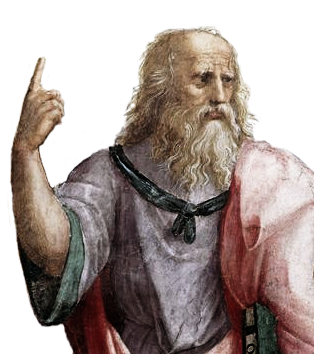
Pay attention to the logical circle: leonardo is sometimes recognized in a new image because it resembles the Turin sanguine, then this resemblance is used to prove that the sanguine is a self-portrait. On the contrary, art history must maintain separate attribution of the sheet and identity of the model.
The face in his work
What his paintings reveal about his obsession with expression

The Mona Lisa
The face is never frozen: the shadows, gaze and corners seem to change depending on the distance.
See reproduction →
Saint John the Baptist
The smile and the raised finger produce a psychological presence that goes beyond a simple portrait.
See reproduction →Continue investigation
Life, surroundings and personality
Sources and verification
References to distinguish portrait and attribution
FAQs
The true face of Leonardo da Vinci
Is there a certain self-portrait of Leonardo da Vinci?
No. The famous drawing in the Turin red chalk is indeed attributed to Leonardo, but his identification as a self-portrait remains debated.
Which portrait best shows his true face?
The profile drawn by Francesco Melzi is often considered the most valuable testimony, because Melzi knew Leonardo personally. However, it remains a profile drawing and not an identity photograph.
Did Leonardo really have a long beard?
Images linked to his later years show him bearded and hairy. The spectacular beard length was later amplified by posthumous portraits and imagery of patriarchal genius.
Is Lucanie's portrait authentic?
The panel is old and intriguing, but its attribution as a self-portrait painted by Leonardo is not accepted by consensus. It must be presented as contested.
Did Raphael represent Leonardo in The School of Athens?
Tradition often identifies Plato's features with those of Leonardo. The idea is plausible, but it does not constitute a certain documentary identification.
What did Leonardo look like when he was young?
We have no unanimously recognized portraits of youth. The texts describe him as handsome, strong, elegant and sociable; the images available mainly concern mature or aging men.
0 comments