

Libro di pittura · Melzi · 1651
The Treaty paint
Not a manual completed by Leonardo, but a posthumous architecture of his notes: how to see, compose, illuminate, represent movement and make painting a science.


The short answer
What does the Treatise on Painting contain?
Hundreds of remarks on the status of painting, painter's training, perspective, light, colors, the human body, movements, draperies, landscapes, clouds, water and composition. His central idea: painting requires understanding how the world becomes visible.
The text we are reading is already an edition
Leonardo projected several books and continually rewrote his notes. After his death, Francesco Melzi selected, copied and classified a large part of the passages in the future Libro di pittura. The current order therefore reflects both Leonardo and the work of transmission.
I · Birth of the book
From thousands of notes to a posthumous treatise
Leonard notes
Observations, definitions, exercises and draft chapters accumulate over decades.
Melzi gathers
His student and heir organized extracts by theme in the manuscript now called Codex Urbinas Latinus 1270.
Copies abbreviate
Shorter handwritten versions circulate, move or omit passages and their figures.
1651 prints
A French and Italian edition appeared in Paris, well after the master's death.
Treatise or "Painting Book"?
Libro di pittura refers more aptly to the large handwritten compilation. "Treatise on Painting" is the title under which the editorial work has established itself in modern editions.
II · Summary
Reasoning in five movements
| Movement | Question | Leonard's response |
|---|---|---|
| 1 · Defend | Why is painting a superior knowledge? | Because it is based on vision, simultaneously embraces relationships and gives presence to absent things. |
| 2 · Train | What should the painter learn? | Perspective, proportions, light, anatomy, gestures, nature and constant practice of drawing. |
| 3 · Observe | How to avoid formulas? | Study the real variety of faces, ages, movements, species, atmospheres and accidents. |
| 4 · Build | How to make a scene readable? | Order figures, contrasts, directions and intervals according to the main action. |
| 5 · Bring life | What's a successful figure? | A body whose attitude makes visible the intention, emotion and relationship with others. |
III · The essential principles
Eight rules for understanding your painting

Painting is a science
Understanding light, space and the body helps imitate causes, not just surfaces.

Perspective has many faces
The reduction of shapes, the weakening of contrasts and the change of colors together build distance.
Shadow gives relief
The shape becomes credible when light, halftone, clean shadow and cast shadow are coordinated.

Body expresses mind
Gestures, looks, attitudes and relationships between figures must make interior movements legible.
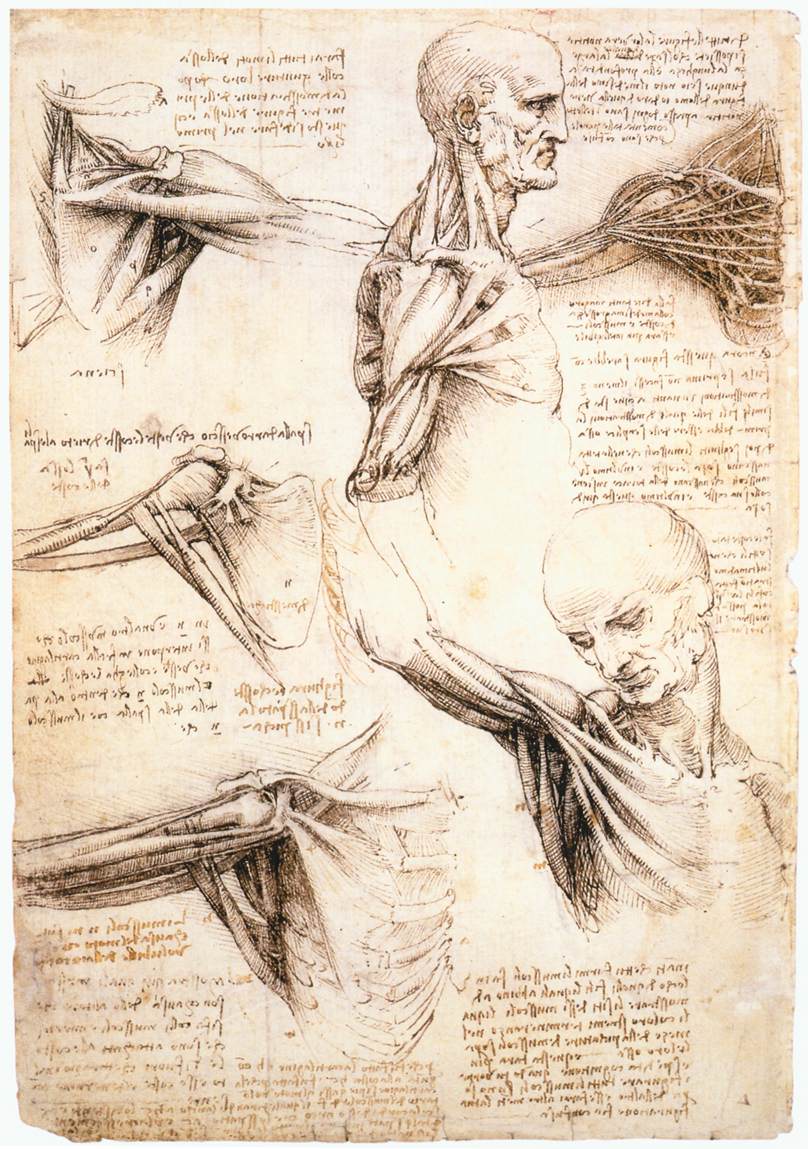
Painter must know anatomy
Bones, muscles and joints prevent painted movement from becoming arbitrary.

Composition organizes action
Groups, intervals, directions and contrasts lead the gaze without freezing the story.

Nature varies without repeating itself
Ages, faces, bodies, trees, clouds and waters must be observed in their diversity.

Memory must be trained
Observing, retaining then reconstructing helps the painter to represent actions that are impossible to take for long.
IV · Practical advice
What Leonardo asks of the painter
Study before inventing
Master the parts - anatomy, light, gestures - then bring them together in a scene.
Vary the figures
Do not repeat the same face, pose or age under different costumes.
Match the gesture
Attitude should suit the character's intention, rank, age, and effort.
Avoid artificial contours
Nature does not surround every shape with a black line; the limit depends on the light and the background.
Compare contrasts
Light appears strong or dim depending on its surroundings.
Observe the stains
Walls, clouds and indeterminate shapes can stimulate invention, provided they are then disciplined.
Work on memory
Briefly remember an action seen in the street, then redraw it to correct the observation.
Know without showing everything
Anatomy supports the painted body; it must not transform each figure into a medical board.
Unify the scene
Light, air, ground and gestures must belong to the same physical world.
The famous stain method
Leonardo advises looking at stained walls, ashes, clouds or mud to discover possible landscapes and figures. He does not propose chance as a finished work: he uses it as a trigger for the imagination.
V · Painting and poetry
The "paragon": why painting rivals the arts
| Comparison | Argument attributed to Leonardo | Limit to keep in mind |
|---|---|---|
| Painting/poetry | The image simultaneously presents what words unfold over time. | The controversy values the painter's profession; it is not a neutral media theory. |
| Painting/sculpture | The painter recreates relief, light, color, atmosphere and distance on a flat surface. | Leonardo also knows sculpture and sometimes simplifies the sculptor's constraints. |
| Eye/ear | Vision immediately transmits spatial relationships. | The transmitted text was selected and ordered after his death. |
VI · The text facing the works
Three tables as demonstrations
The Mona Lisa
Shadow relief, faded contours, atmospheric landscape and mental movement of the face.
See reproduction →The Last Supper
Main action, varied groups, readable gestures, perspective and contrast between central calm and agitation.
See reproduction →Saint Anne
A stable pyramid becomes alive thanks to twists, looks and continuity of gestures.
See reproduction →Water as a model
Swirls, reflections, transparency and movement show how scientific observation nourishes painting.
VII · How to read it
Choose an edition without confusing the texts
Codex Urbinas Latinus 1270
The large handwritten compilation, the most extensive to understand the editorial project transmitted by Melzi.
1651 edition
Founding printed text, French and Italian, but based on an abridged version and a complex editorial history.
Modern critical editions
They compare manuscripts, place passages in their sources and point out variations, gaps and interventions.
Don't read an isolated quote as a definitive sentence
Translations vary, some passages exist in several editorial offices and the thematic order is posthumous. A quotation must be accompanied by its chapter, its edition and, if possible, its source manuscript.
Digital sources
Consult the text and its history
French edition of 1651
Digital facsimile and text search.
Biblioteca LeonardianaE-leo project
Manuscripts, Libro di pittura and historical editions.
BnFTreated from 1651
Notice of the bilingual edition and its critical reissue.
Museo GalileoCodex Urbinas
Compilation, transmission and first impression.
Continue
Put the principles into practice
FAQs
Questions about the Treaty
Did Leonardo write the Treatise on Painting?
The ideas and writing come from his manuscripts, but the transmitted book was compiled and organized after his death, mainly by Francesco Melzi.
When was it published?
The first printed edition appeared in Paris in 1651, in French and Italian.
What is Codex Urbinas Latinus 1270?
The manuscript retaining the most complete compilation of the Libro di pittura, made from the writings of Leonardo.
What is the most important principle?
Painting must understand the laws of visibility - light, space, body and movement - to give the appearance of life.
Does the Treaty explain sfumato?
It largely develops light, shadow, contours and atmosphere, essential principles of sfumato, even if the exact material practice is not reduced to a recipe.
Can it be read for free?
Yes, the 1651 edition and several manuscripts are available in the e-Leo digital library.
0 comments