

Florence · 1469 -1482 · 1500 -1506
Leonardo da Vinci in Florence
Training at Verrocchio, first works, unfinished commissions and face-to-face with Michelangelo.

The short answer
Florence trains Leonardo, then challenges him
Leonardo arrived in Florence at a young age, where his father directed him towards Andrea del Verrocchio's versatile workshop. There he learned drawing, painting, sculpture, construction site mechanics and collaboration between specialists. His first independent works already show his obsession with air, water, movement and light transitions.
After almost twenty years in Milan, he returned around 1500 to a republican Florence. This second period produced the cardboard of Saint Anne, the Mona Lisa and the monumental commission for the Battle of Anghiari. In the Palazzo Vecchio, his project is compared to that of the young Michelangelo: a competition that has become a symbol of the Renaissance.
Two stays
Florentine chronology
Between apprenticeship, departures and returns, Florence remains the reference point of her career.
Entrance to Verrocchio's workshop
Leonardo trained in one of the most active workshops in Florence, through contact with painting, bronze, goldsmithing and public decorations.
Registration with the Saint-Luc company
He is recognized as a painter, while remaining linked to Verrocchio's environment and the collective practice of the workshop.
First paintings and commissions
Baptism of Christ, Annunciation, portraits, studies and Adoration of the Magi build a still unstable reputation.
Departure for Milan
The Adoration remains unfinished. Leonardo sought from Ludovic Sforza a larger field for his skills as an artist and engineer.
Return, Mona Lisa and Anghiari
He returns famous, works on several major projects, dialogues with the Republic and indirectly confronts Michelangelo.
The workshop
Verrocchio: learn all trades
The "bottega" is not a silent school, but a company where several hands construct a work.

Observe, draw, prepare, collaborate
Verrocchio leads commissions for painting, sculpture, metal and decor. Young Leonardo learns to prepare a panel, transfer a drawing, grind pigments and integrate its part into a composition designed by the master. THE Baptism of Christ is the crucial example of this collective functioning.
Vasari says that the angel painted by Leonardo discouraged Verrocchio from continuing the painting. The anecdote is famous but late. The work itself shows above all an evolution of language: the angel, the flesh and the landscape seem unified by the air rather than cut out by the outline.
Study gestures, drapes, plants and expressions.
Superimpose oils and glazes to soften transitions.
Thinking about bodies in space and from multiple angles.
Understand materials, mechanisms and organization of the site.
Commented gallery
Five works to understand Florence
Images are displayed in full and can be opened wide.
Enlarge ↗The Baptism of Christ
The young Leonardo notably paints the angel on the left and intervenes in the landscape. The work allows us to see how a collective workshop creation becomes a laboratory of new textures, light and atmosphere.
See reproduction →Enlarge ↗The Annunciation
The perspective space remains Florentine, but the observed wings, the flowery meadow, the twilight light and the distant blue already announce Leonardo's method: uniting visual experience and mental construction.
See reproduction → Enlarge ↗
The Adoration of the Magi
Commissioned for San Donato a Scopeto, the painting remained unfinished when Leonardo left for Milan. Its condition reveals the movements of the figures, the repetitions and the swirling construction of the scene.
See reproduction → Enlarge ↗
The Battle of Anghiari
Intended for Palazzo Vecchio, the painting confronts men and horses in a compact struggle. The original has disappeared; copies, engravings and studies, however, allow us to rebuild our energy.
See reproduction → Enlarge ↗
The Mona Lisa
Lisa Gherardini's portrait is generally linked to the second Florentine stay. Leonardo keeps it, takes it back and takes it with him, transforming a portrait commission into an unclosed work.
See reproduction →Palazzo Vecchio
Leonardo facing Michelangelo
The rivalry is real in the public system, but stories of personal hostility have often been amplified.
The Battle of Anghiari
A melee of horsemen around a standard. Leonardo concentrates the war in the faces, bites and twists of horses.
Two monumental boxes intended for the Grand Council room of Palazzo Vecchio.
The Battle of Cascina
Naked soldiers surprised during the bath. Michelangelo transforms the military alert into an anatomical and sculptural demonstration.
The face-to-face that never really happened: neither project was completed as planned. The boxes were admired, copied and then dispersed; Leonardo's painting deteriorated and disappeared. Their confrontation survives mainly through studies and copies.
Urban route
See Leonardo's Florence today
Four steps are enough to connect works, commissions and rivalries.
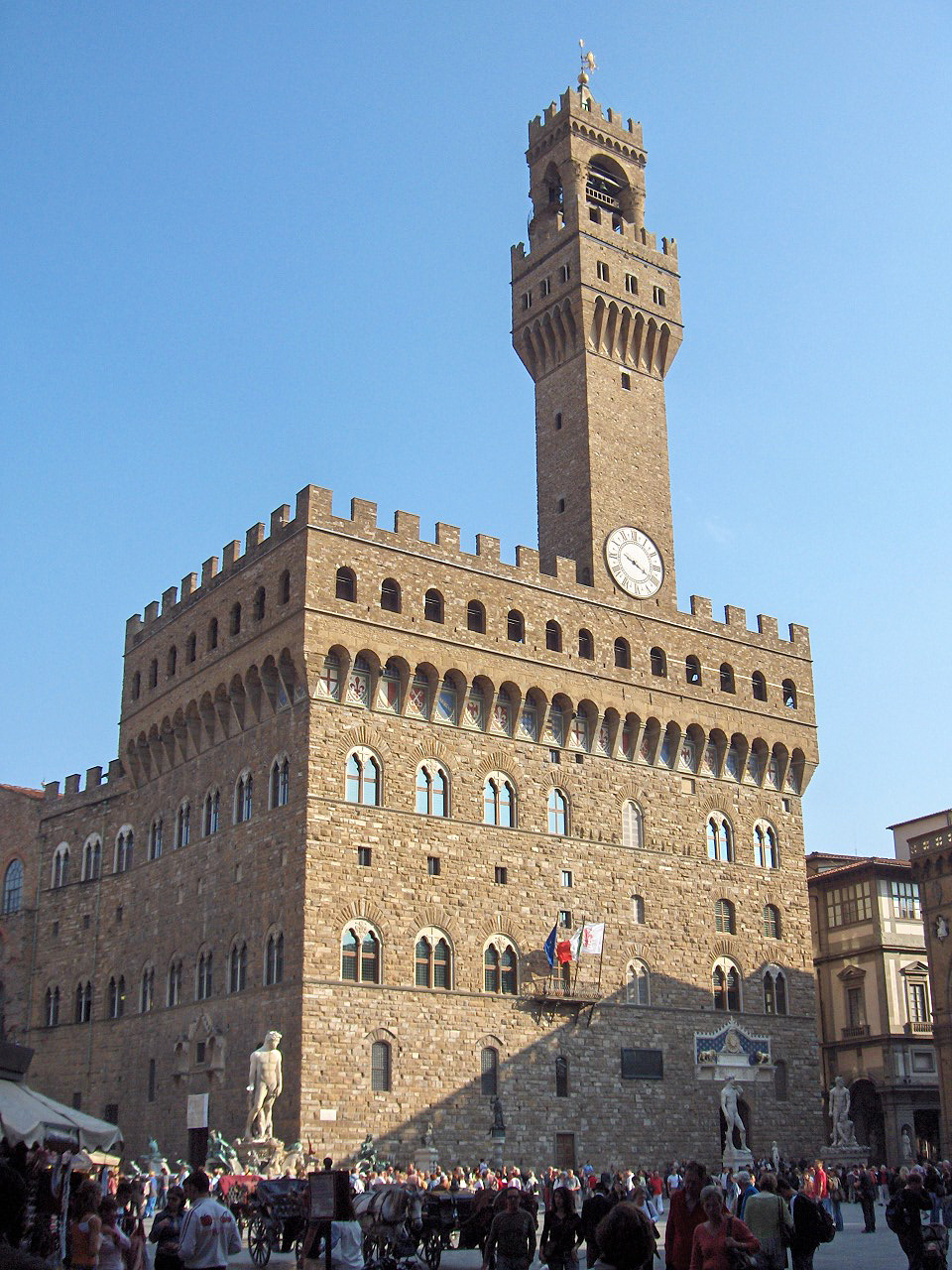
From the museum to the city
Start at the Uffizi, where the three major early paintings are brought together in the Leonardo room. Then join the Palazzo Vecchio, place of Anghiari's commission, then the sites linked to the works and the sponsors. The route does not reconstruct a vanished workshop: it connects institutions and documented spaces.
Uffizi Gallery
Baptism, Annunciation and Adoration.
Palazzo Vecchio
Grand Council Hall and memory of Anghiari.
Santissima Annunziata
Place associated with the Sainte Anne cardboard exhibited to the public.
Monte Oliveto
Florentine origin of the Annunciation before its entry into the Offices.
Continue
Related guides and collection
Official sources
Works and context
FAQs
Questions about Leonardo in Florence
Where did Leonardo da Vinci train in Florence?
In the workshop of Andrea del Verrocchio, a versatile structure active in painting, sculpture, metal and decoration.
What works by Leonardo to see at the Uffizi?
The Baptism of Christ, carried out with Verrocchio and collaborators, The Annunciation and The Adoration of the Magi unfinished.
Did Leonard and Michelangelo work in the same room?
They received orders for the Grand Council room of Palazzo Vecchio: Anghiari for Leonardo and Cascina for Michelangelo. No definitive set was completed.
Does the Battle of Anghiari still exist?
The original is lost. The composition is known thanks to studies, copies and engravings, including the famous interpretation associated with Rubens.
Was the Mona Lisa painted in Florence?
It is generally considered to have begun in Florence around 1503, during the second Florentine stay, then resumed for several years.
0 comments