
Connect name and nature
Ginevra appears in front of the juniper tree and a moral emblem. This milestone sheds light on the "Portraits of Women by Leonardo da Vinci" collection, favoring figures.
Around 1474 -1519 · gaze, interior movement and landscape
Discover Portraits of Women by Leonardo da Vinci, hand reproduced in oil on canvas.

Around 1474 -1519 · gaze, interior movement and landscape
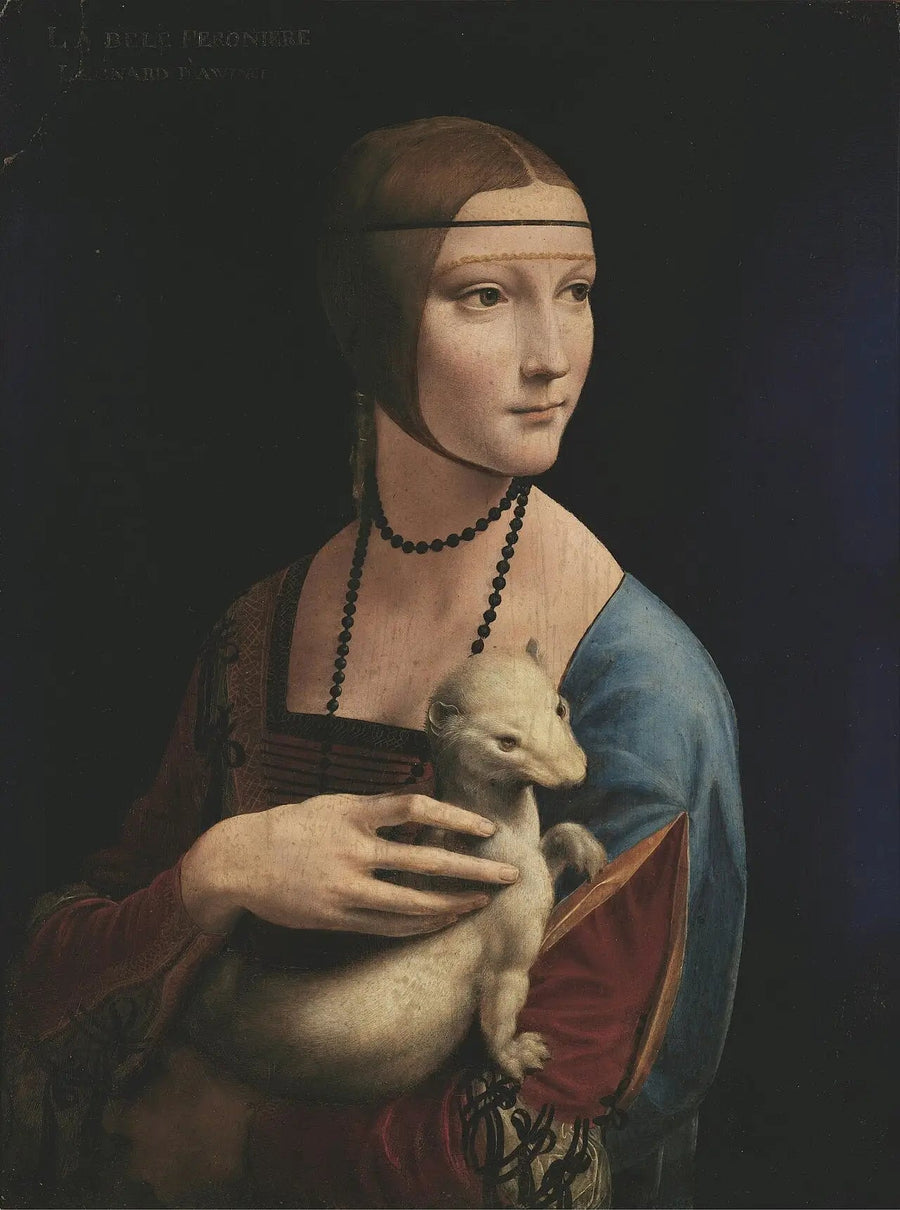
Leonardo da Vinci's female portraits cover a decisive evolution. Ginevra de' Benci, painted in Florence, stands out in front of the juniper tree which plays on her first name and identity; the reverse combines motto and emblems. The Lady with the Ermine represents Cecilia Gallerani, linked to Ludovic Sforza: the joint movement of the young woman and the animal makes a presence felt off-camera. La Belle Ferronnière, traditionally named thus without certainty of identity, uses parapet, jewelry and sideways gaze to establish a firmer distance. La Belle Ferronnière, traditionally named thus without certainty of identity, uses parapet, jewelry and sideways gaze to establish a firmer distance. La Belle Ferronnière, traditionally named thus without certainty of identity, uses parapet, jewelry and sideways gaze to establish a firmer distance. La Belle Ferronnière, traditionally named thus without certainty of identity, uses parapet, jewelry and sideways gaze to establish a firmer distance. La Belle Ferronnière, traditionally named thus without certainty of identity, uses parapet, jewelry and sideways gaze to establish a firmer distance. La Belle Ferronnière, rather than limits. These works were commissioned in specific social contexts, but Leonardo goes beyond the inventory of rank. The selection "Portraits of women by Leonardo da Vinci" notably compares Portrait of Ginevra by Benci and The Lady with the Ermine. His reading favors figures.
In Leonardo, the female portrait does not stop: eyes, hands, animal and landscape prolong a movement that the frame never closes.
Course & style
Leonardo da Vinci's female portraits cover a decisive evolution. Ginevra de' Benci, painted in Florence, stands out in front of the juniper tree which plays on her first name and identity; the reverse combines motto and emblems. The Lady with the Ermine represents Cecilia Gallerani, linked to Ludovic Sforza: the joint movement of the young woman and the animal makes a presence felt off-camera. La Belle Ferronnière, traditionally named thus without certainty of identity, uses parapet, jewelry and sideways gaze to establish a firmer distance. La Belle Ferronnière, traditionally named thus without certainty of identity, uses parapet, jewelry and sideways gaze to establish a firmer distance. La Belle Ferronnière, traditionally named thus without certainty of identity, uses parapet, jewelry and sideways gaze to establish a firmer distance. La Belle Ferronnière, traditionally named thus without certainty of identity, uses parapet, jewelry and sideways gaze to establish a firmer distance. La Belle Ferronnière, traditionally named thus without certainty of identity, uses parapet, jewelry and sideways gaze to establish a firmer distance. La Belle Ferronnière, rather than limits. These works were commissioned in specific social contexts, but Leonardo goes beyond the inventory of rank.
Ginevra appears in front of the juniper tree and a moral emblem. This milestone sheds light on the "Portraits of Women by Leonardo da Vinci" collection, favoring figures.
Cecilia and the ermine react to an off-camera presence.
Mona Lisa unites face, air and landscape through sfumato.
The plant associates the name Ginevra with virtue and portraiture. This trait guides a reading of "Portraits of Women by Leonardo da Vinci" centered on the figures.
The animal repeats the movement of the model and densifies the off-camera.
La Belle Ferronnière uses this limit to adjust the distance.
Passages without a hard line give the face optical mobility.
Explore by universe
Emblem, movement, distance and atmosphere explain why these portraits are not reduced to their identity.
Juniper transforms the background into personal language.
For Florence. Reading of "Portraits of Women by Leonardo da Vinci" by the figures.Woman and animal turn together towards an invisible event.
For MilanLook, jewelry and parapet affirm a controlled presence.
For authorityThe sfumato circulates air between figure and world.
For maturityJuniper and emblems connect resemblance, identity and virtue.
Landmark work of Portraits of Women by Leonardo da VinciThe bust, the gaze and the animal react together to a presence located outside the frame.
Landmark work of Portraits of Women by Leonardo da VinciWorks to discover
The selection brings together Ginevra de' Benci, the Lady with the Ermine, the Beautiful Ironworker and Mona Lisa.


Our method
Each painting is made in oil on canvas by a specialized artist, then checked with you before shipping.
Each reproduction is unique. Slight variations of touch and material testify to the painter's manual work.
Choose wisely
Vertical format faithful to proportions, brown, black or dark wood frame. Place eyes at eye level and avoid bright frontal light.
Frequently asked questions
Yes. Each reproduction is hand painted in oil on canvas, without printing.
The painter uses the composition, values, colors and materials visible in the chosen work from Leonardo da Vinci's Portraits of Women collection, with particular attention paid to the figures.
Yes. The dimensions are adapted respecting the proportions and balance of the selected work.
Detailed photographs are sent before shipping; you can request edits before sending.



reproduction custom
Send us an image, a museum reference or the name of a work: we can make one reproduction personalized.
Buying guide
From your choice to delivery, you stay in control thanks to photo validation and included retouching.
Select the painting and the dimensions suitable for your interior.
Your reproduction is made by hand, in painting at oil on canvas.
You receive a photo and can request up to 7 sets of edits.
After validation, it is protected, rolled and sent with FedEx tracking.
Advice & guarantees
Simple answers on the painting by hand, formats, alterations and delivery of your reproduction.
The essential points before choosing your reproduction.
Yes. Every reproduction is made by hand in painting at theoil on canvas by an experienced artist. This is neither a print nor a printed canvas.
Yes. Before shipping, we send you a detailed photo of the canvas. Up to 7 sets of edits are included to adjust the rendering before your validation.
The estimated date is displayed near the buy button. It includes the time of painting, your photo validation then FedEx tracked delivery.
Yes, you can choose a standard format or ask us for a custom size to suit your space.
Depending on the options available, the canvas can be delivered alone, mounted on a frame or prepared for framing. Details are shown on the product page.
Yes. You can send us an image, museum reference, name of a work or photo to request one reproduction personalized.
Some useful guidelines for choosing a work, its format and the location that will best highlight it.
This selection brings together works designed for art lovers who want to rediscover the spirit of one painting famous in a hand painted canvas. Each reproduction can be adapted to the desired format and validated in photos before shipment.
The available formats allow the work to be adapted to a more specific living room, bedroom, office or decorative project. There painting is carried out at theoil on canvas with particular attention to colors, textures and general balance.
If you are looking for a similar work, a similar artist or a specific format, you can ask for advice. Reproductions can be adjusted before sending using photo validation.