1
You choose the size
Select the desired size before ordering.


Reproduction sur toile
Le format s'adapte automatiquement au tableau original.
Peinture à l'huile sur toile roulée, sans cadre. Taille personnalisée sur demande.
Explore the subjects and styles associated with this reproduction.
Artwork description
An oil-on-canvas reproduction of an iconic female portrait from the Renaissance, worked from direct observations of the model: fair complexion, curly hair, a steady gaze set against dense foliage and a wooded horizon.

Three essential points of reference
Half-length portrait of a young woman seen in three-quarter view, with a direct gaze and a restrained expression, in the tradition of Italian Quattrocento portraiture.
Oil-on-canvas reproduction reproducing the fine crackle, the soft transitions of the pale complexion, and the dark density of the foliage.
Work attributed to Leonardo da Vinci, associated with Italian Renaissance collections and held at the National Gallery of Art in Washington.
Visual analysis
The portrait is organized around a tight half-length framing, seen in three-quarter view, which gives the face a slight turn and directs the gaze out of the picture. The young woman presents a very pale, almost translucent complexion, set off by fine lips and a neutral, almost hieratic expression. Her chestnut hair, short and tightly curled, frames the face by drawing a dense volume that responds to the dark mass of the bush placed behind her.
The costume plays on a restrained and precious palette. An ochre-brown dress, trimmed with gold at the neckline, structures the silhouette. A wide black stole crosses the shoulders and anchors the upper body in a deep shadow zone. At the center of the chest, a vivid blue lacing appears over a white garment, creating a chromatic focal point that breaks the sobriety of the brown and black.
The background is treated in two zones. In the center, a bush with dark, pointed leaves forms a compact vegetal screen that enhances the fair complexion. On the right, the setting opens up: trees, a stretch of water, bluish mountains in the distance, beneath a sky of uniform light blue. This contrast between the dark vegetal mass and the luminous horizon brings a breathing space to the composition.
The pictorial material preserves the fine crackle of the original panel, a testament to the time elapsed since the work was created, and gives the reproduction a patinated character, close to the original.
Historical context
Attributed to Leonardo da Vinci, this portrait belongs to the tradition of the late Quattrocento in Florence, a period when the Tuscan city saw the flowering of the female psychological portrait. The work is today associated with the Italian Renaissance collection and figures among the famous paintings connected to the National Gallery of Art in Washington, D.C.
In the Florence of the 1470s and 1480s, court portraiture followed precise codes: a three-quarter pose, a direct gaze, the sitter set within a vegetal decor, sometimes a landscape, which becomes the symbolic extension of her inner life. The presence of the dense bush behind the young woman, contrasting with an open horizon on the right, is part of this visual grammar where nature accompanies the portrait rather than simply decorating it.
The work enters history as one of the rare female portraits confidently attributed to Leonardo da Vinci, and stands, alongside Lady with an Ermine and the Mona Lisa, as a major reference of Leonardesque portraiture.
Style and manner
The Leonardesque manner is recognizable in several clear choices visible in the painting. The light comes mainly from the left and models the volumes of the face through gradual passages, with no sharp break between lit and shadowed areas. The modeling of the flesh relies on fine tonal transitions that dissolve the contours into the atmosphere.
The palette combines warm browns, deep blacks, a golden ochre, and an almost lapis blue, lifted by the white of the inner garment. The curly hair is worked in tight, almost miniature touches that restore the density of the hair without detailing each strand. The dark foliage in the background is treated in modeled flat areas, while the distant landscape uses the washed-out blues typical of the atmospheric backgrounds of the Italian Renaissance.
This alliance between precision of detail and dissolution of contours paves the way for the evolution of the European portrait toward the 16th century and sets Leonardo da Vinci durably apart from his Florentine contemporaries.
Decorative appeal
A half-length portrait of this intensity naturally finds its place in a room where one seeks a sober figurative presence, without narrative overload. Above a sideboard, a chest of drawers, or a desk, it becomes the visual focal point of a wall and dialogues with woodwork, natural textiles, or aged patinas.
Its palette of browns, ochre, and deep blue pairs particularly well with interiors in stone, linen, taupe, or moss green tones, where the oil medium of the portrait dialogues with raw materials — light wood, aged leather, matte ceramic. In a generously proportioned living room, a bedroom with soothing tones, or a study with character, the work brings a Renaissance note without any pastiche effect.
To preserve the legibility of the face, plan for an uncluttered wall and indirect lighting, which enhances the soft transitions of the modeling without flattening the details.
Handcrafted reproduction
The oil-on-canvas reproduction is worked by hand, layer after layer, to restore the density of the original medium. The light impastos follow the lit areas of the face and hands, while the finer passages reproduce the softness of the modeling on the temples, the forehead, and the cheek.
The brush edges remain perceptible in the curly hair and in the dark foliage, giving the surface that vibration unique to oil painting. The transitions of the sky, the distant blue of the mountains, and the deep green of the bush are obtained through superimposed glazes, which create gradual passages between the tones.
The fine crackle of the pictorial material, inherited from the old panel, is reproduced with regularity, to preserve the patinated appearance of the original model. The canvas is delivered rolled, ready to be stretched or displayed according to the decorative project.
The reproduction is made on canvas and shipped rolled, without a frame provided, in order to facilitate transport and final installation.
Practical questions
The painting represents a young woman seen in three-quarter view, with a fair complexion and tightly curled chestnut hair. The title of the work identifies her as Ginevra de' Benci, a figure of late Quattrocento Florence.
The work belongs to the Italian Florentine Renaissance, at a time when Leonardo da Vinci was developing a new language of the female psychological portrait.
The reproduction is worked in oil on canvas, in successive layers, to restore the pictorial density, the fine crackle, and the soft transitions of the original model.
A Renaissance portrait fits ideally in a living room, a study with character, or a bedroom with soothing tones, on an uncluttered wall, with indirect lighting that enhances the modeling.
The reproduction is delivered rolled, without stretcher or frame, in order to leave each buyer free to choose the mode of presentation suited to their interior.
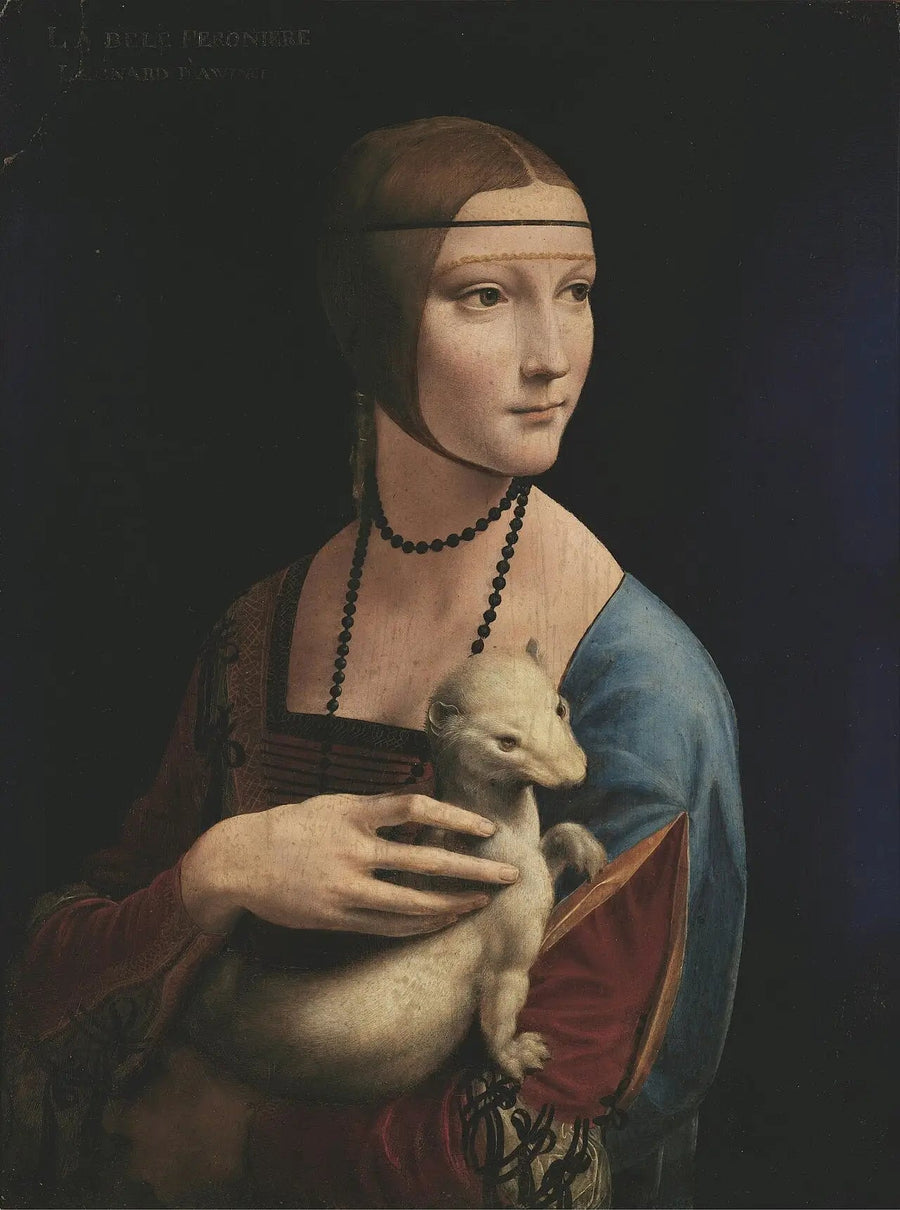
The Leonardo da Vinci collection notably brings together the Mona Lisa, Lady with an Ermine, Madonna Litta, The Virgin, the Child Jesus, and Saint Anne, as well as Bacchus and The Annunciation.
Choosing the oil-on-canvas medium for a Renaissance portrait means opting for the density, depth, and vibration of a pictorial gesture transmitted by hand. Select your format from the available options.


Custom order
A simple and reassuring process, from selecting the size to the tracked delivery of your canvas.
Select the desired size before ordering.
Your reproduction is hand-painted entirely in oil.
We send you a photo to validate the result before shipping.
You receive your canvas rolled, protected, and shipped with tracking.
Same artist
Continuez avec des œuvres connues du même artiste, sélectionnées pour comparer les sujets, les formats et les ambiances sans mélanger avec les styles génériques.