

Saint-Rémy-de-Provence June - December 1889
Van Gogh's Olivesa series between mistral and rhythm
These are not fifteen repetitions of the same landscape. Van Gogh makes each olive grove a state of the world: white heat, violent wind, pink soil, yellow sky, silent harvest.
Here is the series placed in its true calendar, the main versions compared, the letters which explain its ambition and a visual guide to recognize how the mistral becomes line, color and cadence.
in 1889

The short answer
The Olives are a series, not a single painting
Van Gogh painted fifteen olive grove canvases near the asylum of Saint-Paul-de-Mausole between June and December 1889. The motif remains close, but the time, the wind, the ground, the sky and the construction of the touch constantly change.
The French title varies depending on the collections: The Olives, Olive grove, Olives with the Alpilles or Women picking olives. This diversity of titles should not mask the unity of the project. Van Gogh returns to the same tree as Monet returns to a millstone or a cathedral: not to copy, but to experience what light and his own writing can transform.
The first paintings are born at the beginning of summer, when the heat and the mistral make the landscape almost electric. In the fall, the greens become duller, the land is tinged with pink, red ocher or purple. In November, he announced five large olive orchards painted with different colored effects. In November, he announced five large olive orchards painted with different colored effects. In November, he announced five large olive orchards painted with different colored effects. In November, he announced five large olive orchards painted with different colored effects. The last scenes introduce the pickers: the plant rhythm then meets that of human work.
The word "rhythm" is not decorative. The trunks twist, the foliage turns in masses, the mountains roll and the lines of the ground respond to each other. The painting does not mechanically imitate the wind: it reconstructs its thrust.
A Provençal motif
The olive tree is everyday around Saint-Rémy, but its irregular silhouette and changing leaves pose an exceptional painting challenge.
A series of colors
Silver, blue, green, bronze, yellow, pink, purple and red ocher move the pattern from one canvas to another.
A spiritual landscape
Van Gogh seeks a religious emotion in observed nature, without inventing a conventional biblical scene.

The real landscape
A few steps from Saint-Paul-de-Mausole
After the Arles crisis, Van Gogh was admitted to Saint-Rémy in May 1889. He had a room and a room to work in. Initially limited to the garden and the views close to the establishment, he gradually resumed his outings in the countryside. Wheat fields, cypresses, Alpilles and olive trees form a tight vocabulary which he deepens instead of dispersing it.
Olive groves are not an exotic setting. These are cultivated plots, crossed by the wind and linked to the agricultural calendar. The painter observes them in summer, at the end of September, then during the harvest. His view remains very concrete: color of the leaves seen above or below, blue shadow, dry earth, slope, distance from the mountains.
In a July letter, he brings the gray and silver olive trees closer to the northern tadpole willows. Provence therefore also reactivates a Dutch memory: same powerful trunks, other light, other speed of the air.
The series calendar
Four campaigns, four temperatures
The chronology helps not to confuse all the paintings under a generic title. Above all, it shows that Van Gogh returns to the motif after each interruption, with a new pictorial problem.
Warmth and relief
The first large olive trees are associated with the Alpilles. The contours are supported, the ground seems raised and the mountain responds to the curves of the trees.
Silver and mistral
Van Gogh describes gray and silver leaves in a very strong wind. The tree is studied as a mass that changes face with each gust.
Resumption by study
A small oil preserved in Amsterdam seeks a new point of view. The diagonals in the foreground collide with the radiant touches of the foliage.
Variations and harvest
Five large orchards are announced in November, each with a different sky and earth effect. The pickers then appear in three versions.
Read the work
Six details that set the whole landscape in motion
The main image is shown as a whole. The markers indicate how each area receives its own family of gestures without breaking the general unity.
123456The sky
Curved keys do not describe precise clouds. They give the air density and direction.
The trunks
Blue, brown or purple contours isolate twists without freezing them. Each tree maintains a unique silhouette.
The foliage
The small masses change tone as if the gust is turning the silver leaves.
Shadows
Blue does not copy a local color: it cools the soil and brings out yellows and oranges.
The Alpilles
The chain is simplified into waves. The horizon does not stop the movement, it extends it.
The earth
Short, parallel or crossed lines construct a surface plowed by the eye as much as by agriculture.

The mistral paints
Wind is not an object: it is a grammar
Van Gogh knows the mistral from Arles. In Saint-Rémy, he still notes the frequency and strength of this wind. However, its olive trees do not look like an instant photograph of folded trees. It distributes wind energy throughout the canvas.
The foliage tilts into distinct bouquets. The trunks offer slower, knotty resistance. The mountain lines accelerate or slow down the gaze. In the foreground, the lines almost become a musical scope. This difference in speed between areas produces rhythm.
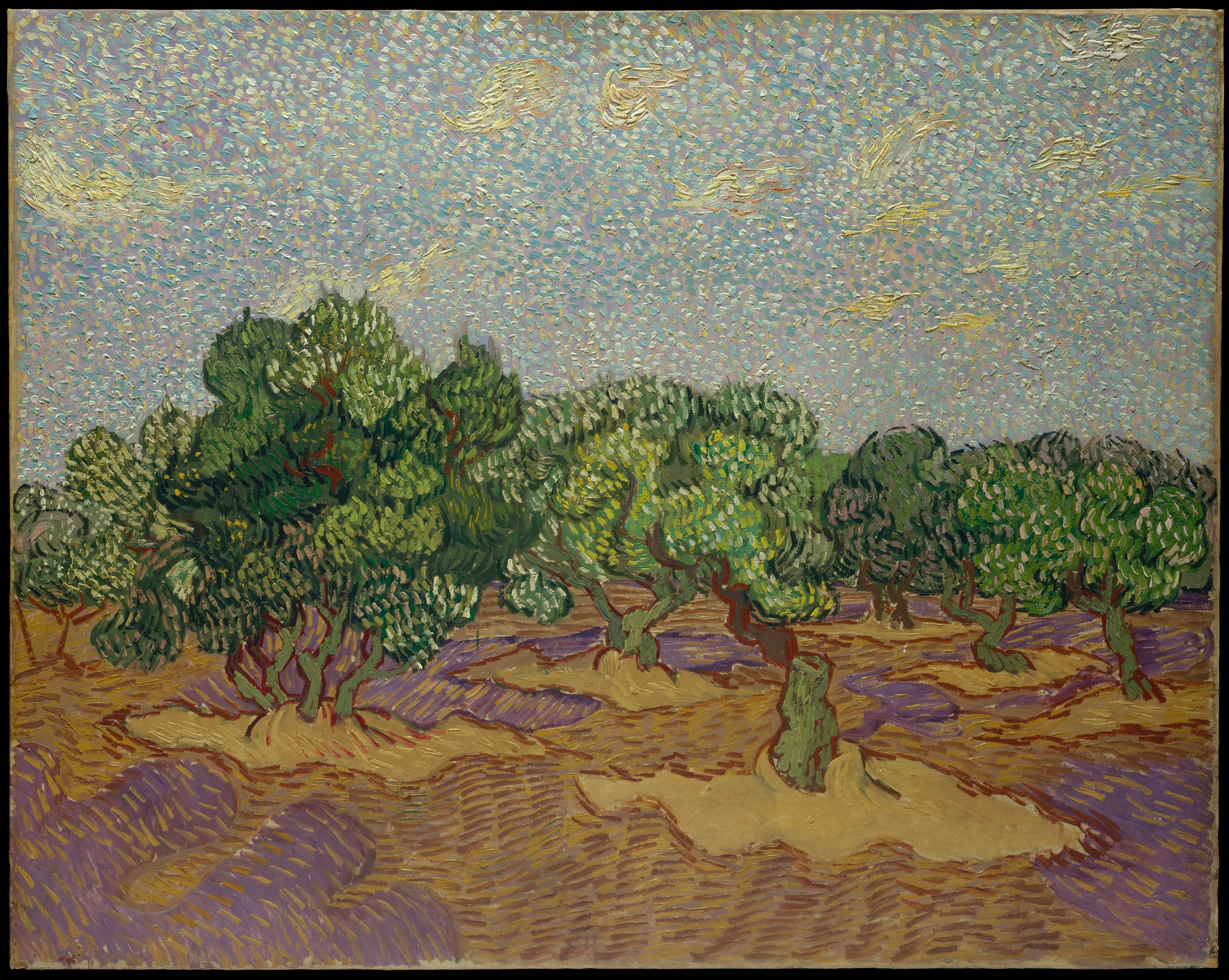
The MoMA canvas is crucial. The heat seems visible in the acidic yellows and vibrant blues. Above the Alpilles, a large white cloud curls like a wave. The museum presents it as a diurnal counterpart of Starry Night same mental landscape, one under the sun, the other under the night sky.
So the painting doesn't just say "it was windy". It makes you feel how the world resists, turns and starts again.
Color according to letters
Silver, bronze, pink and purple: the olive tree changes with the sky
Van Gogh describes a palette much richer than simple green. He looks for the chromatic equivalent of the leaf turning over, the heated floor and the colored shadows.
The clear underside of the leaves and the light which whitens the masses.
A never uniform base, modulated by blue and bronze.
Contours, shadows and cold passages which structure the yellows.
Dry earth, light and heat in the foreground.
Autumn soil and counterpoint to cooled foliage.
Shadows, terrain and sky, to avoid the banality of a green landscape.
In his letter of September 28, 1889, Van Gogh described the olive tree as a motif of extreme difficulty: silver, blue, green, tanned or almost white, placed on yellow, pink, purple, orange or reddish earths.
Faithful paraphrase of letter 806 to Theo van Gogh - spelling and color order vary depending on translation.
Compare versions
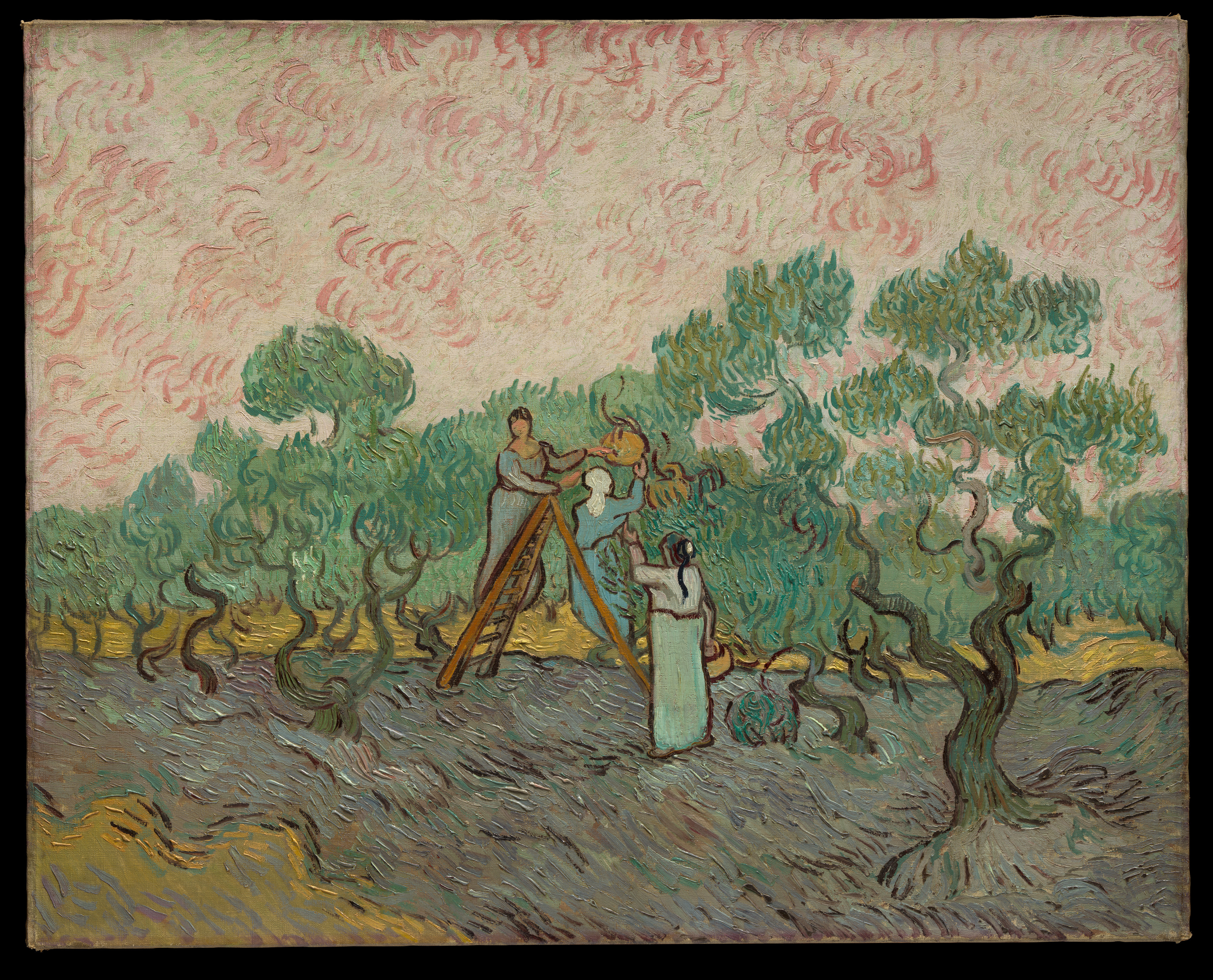
An olive grove, eight ways to make it breathe
This selection does not claim to replace the complete catalog of fifteen paintings. It brings together the best documented variants and allows us to observe what is really changing.



Nature and spirituality
Painting Gethsemane without inventing Christ
The olive trees open a central debate with Gauguin and Bernard: should we start from the imagined religious scene or from observed nature?
Gauguin and Émile Bernard had treated Christ in the Garden of Olives through imagination and symbol. Van Gogh admires certain aspects of their research, but is wary of an invention too far removed from reality. In his letters, he defends work before nature and stubbornly returns to real olive groves.
This does not mean that his paintings would be devoid of spirituality. On the contrary, the effort of the trunks, the permanence of the trees, the harvest and the light create gravity without explicit biblical narration. Religious emotion comes through the earth, not through illustration.
The painter also wants to build a personal emblem. In September, he wrote that he would like to find something as characteristic for olive trees as the yellows of his Sunflowers. The series thus becomes a project of pictorial identity.
Harvest
When the pickers get into the rhythm of the trees
In late 1889, Van Gogh painted three versions of women picking olives. The figures never dominate the scene: they match the work of the orchard.

Bend over, pick up
The figures are curved and small. The harvest reads first as a series of movements rather than a detailed genre scene.
Agricultural autumn
The presence of the pickers places the series in a lived season. Olive trees are not timeless: they produce, are maintained and harvested.
Canvas still visible
In some versions, Van Gogh does not cover everything. Clear reserves lighten the surface and make colored lines breathe.
See the originals
Where are Van Gogh's Olives today?
The series is scattered. The hangings change and the works can travel: always check the museum page before a visit.
MoMA
The big version of June-July with the Alpilles and the white cloud, during the day Starry Night.
Official notice →The Met
A November olive grove and a version of women picking olives, both freely accessible in the catalog.
See the work →Van Gogh Museum
September study, large olive grove in November and drawing with the Alpilles: three complementary states.
Explore the collection →Minneapolis Institute of Art
The only canvas in the series where the sun is directly visible, surrounded by a lively sky.
Visual folder →National Gallery of Art
The Olive Orchard shows three women at work and a surface constructed of free lines.
Official notice →Nelson Atkins Museum
A large olive grove from 1889 documented by a detailed technical and historical file.
Museum file →Kroeller-Müller Museum
The collection retains a summer version of the series, within an exceptional collection of works by Van Gogh.
Prepare the visit →Look without looking for "the best"
Compare key direction, sky position and ground temperature. Each version solves a different problem.
Saint-Rémy around the Oliviers
Four works to understand the same landscape differently
Night, cypresses, flowers and self-portrait show that 1889 is not an isolated parenthesis. The same curved lines and the same contrasts run through the entire period.
Olives with the Alpilles
The Saint-Rémy series in a horizontal composition shown without cropping.
See formats →
Starry Night
The nocturnal counterpart of the Alpilles landscape, built by spirals, cypresses and moving sky.
Discover the work →
Wheat field with cypress
Another confrontation between plants, mountains and air circulation.
See the work →
The Iris
The design of the leaves and the opposition of purple to green in the asylum garden.
See the work →
Self-portrait of Saint-Rémy
The swirls at the bottom pass through the garment and give the portrait a tension comparable to landscapes.
See the portrait →
Almond tree in bloom
After the gnarled olive trees, clear branches on a clear sky celebrate a birth.
See the work →Important collections
Explore Van Gogh by place, genre and movement
These links lead to the ensembles closest to the series: Saint-Rémy, landscapes, museum, masterpieces and post-impressionism.
Continue reading
Eight articles to place the series in the life of Van Gogh
Letters, houses, Arles, Saint-Rémy and major works extend the questions opened by the olive trees.
Letters to Theo
What they reveal about the painter's work, colors, money and ambitions.
BiographyVan Gogh's houses
From Zundert to Auberge Ravoux, all addresses preserved or disappeared.
NightStarry Night on the Rhône
A night in Arles in blue and gold, before the great landscapes of Saint-Rémy.
ArlesVan Gogh in Provence
The stay that prepares for colorful oppositions and series ambition.
SeriesSunflowers
The great serial precedent to which Van Gogh himself compares his olive trees.
ColorThe Room in Arles
How colorful chords build space and emotion.
MuseumVan Gogh Arles Foundation
History, exhibitions and advice for visiting the Provençal city.
ProjectThe Yellow House
The painting, the Atelier du Midi, Gauguin and the disappeared place of Place Lamartine.
Frequently asked questions
Everything you need to know about Van Gogh's Olives
How many olive paintings did Van Gogh paint?
He painted fifteen canvases dedicated to the olive groves of Saint-Rémy between June and December 1889. Drawings and studies on paper complete this group.
Why does Van Gogh paint so many olive trees?
The pattern allows him to study an irregular shape, leaves whose color changes with the wind, colorful lands and a spiritual emotion anchored in real nature.
Where did Van Gogh paint the Olives?
In the countryside near the Saint-Paul-de-Mausole asylum, in Saint-Rémy-de-Provence, with the Alpilles visible in several compositions.
When was the series painted?
The campaigns ran from June to December 1889, with large groups in early summer, September and especially November.
Which painting of the Olives is at MoMA?
MoMA preserves The Olive Trees, painted in June - July 1889, a large canvas with the Alpilles and a white cloud. The museum brings it closer to Starry Night.
What is the connection between the Olives and Starry Night?
The MoMA version is considered a daytime counterpart Starry Night. The two works develop the same landscape of Saint-Rémy through different curves, rhythms and energies.
Is the mistral visible in the paintings?
It is not represented as an object. It is seen in changes in key direction, suggested leaf turning, trunk twisting and circulation from sky to ground.
Why are olive trees blue and silver?
Van Gogh observes the light underside of the leaves and uses complementary colors. The blues cool the shadows and vibrate the yellows, pinks and ochres of the terrain.
Do the Olives represent the garden of Gethsemane?
For Van Gogh, they evoke the spiritual dimension of the Garden of Olives, but do not constitute a literal illustration. He prefers to start from real olive groves rather than invent a biblical scene.
How many versions of olive pickers are there?
Van Gogh painted three versions of women picking olives in late 1889. Copies are notably kept at the Metropolitan Museum and the National Gallery of Art.
Where to see Van Gogh's Olives?
Versions are scattered among MoMA, the Metropolitan Museum, the Van Gogh Museum, the Minneapolis Institute of Art, the National Gallery of Art, the Nelson-Atkins Museum and other collections.
How to choose a reproduction of Olives?
Preserve the horizontal format and the entire canvas. Olive, blue, ocher and pink pairings work particularly well on a cream, warm gray, deep green or muted blue wall.
Verified sources
Museums and correspondence: the evidence behind the analysis
The dates, dimensions, groupings and interpretations were compared with museum notices and the scientific edition of Van Gogh's letters.
The Olive Trees
Instructions, date, dimensions, link with Starry Night and contour analysis.
The MetOlive Trees
Version from November 1889, dimensions, provenance and image with free access.
Van Gogh MuseumOlive Grove
Changing color, underlined trunks, blue shadows and dialogue with Gauguin and Bernard.
Minneapolis Institute of ArtVisual journey
Countdown of the fifteen paintings, calendar and only version directly showing the sun.
Letter 788Mistral and silver leaf
July 1889 description of the gray and silver olive trees downwind.
Letter 806The palette of olive trees
Inventory of greens, blues, bronzes and yellow, pink, purple or orange earths.
Letter 822Five orchards
November work, search for different effects and choice to paint from nature.
National Gallery of ArtThe Olive Orchard
Version instructions with three pickers, technique and image in public domain.
In Van Gogh, the olive tree never holds in place - even when it is rooted.
The series transforms an ordinary plot of Saint-Rémy into a complete painting experience. The mistral becomes direction, the leaf becomes changing color, the mountain becomes cadence and the harvest becomes human measure. Fifteen canvases are enough to show that the same motif can contain fifteen climates.
Discover the reproduction of Olives
0 comments