Top 50 — Renaissance

Famous Renaissance painters

Leonardo da Vinci, Michelangelo, Raphael, Botticelli, Titian and 45 other geniuses of Italian and Northern light

The Renaissance is the birth of modern painting: perspective, light, anatomy, and the individuality of the artist. From Giotto reinventing volume, to Leonardo observing the soul beneath a smile, to Titian liberating color — this Top 50 covers two centuries of Italian, Flemish, and German invention, from the Trecento to the early 16th century.
Wikimedia CommonsWikidataWikipedia
1420 Jan van Eyck's genius in Bruges — official birth of oil painting
150+ Years of Italian and Northern innovation (Florence, Venice, Bruges, Nuremberg)
10 Countries represented in this ranking
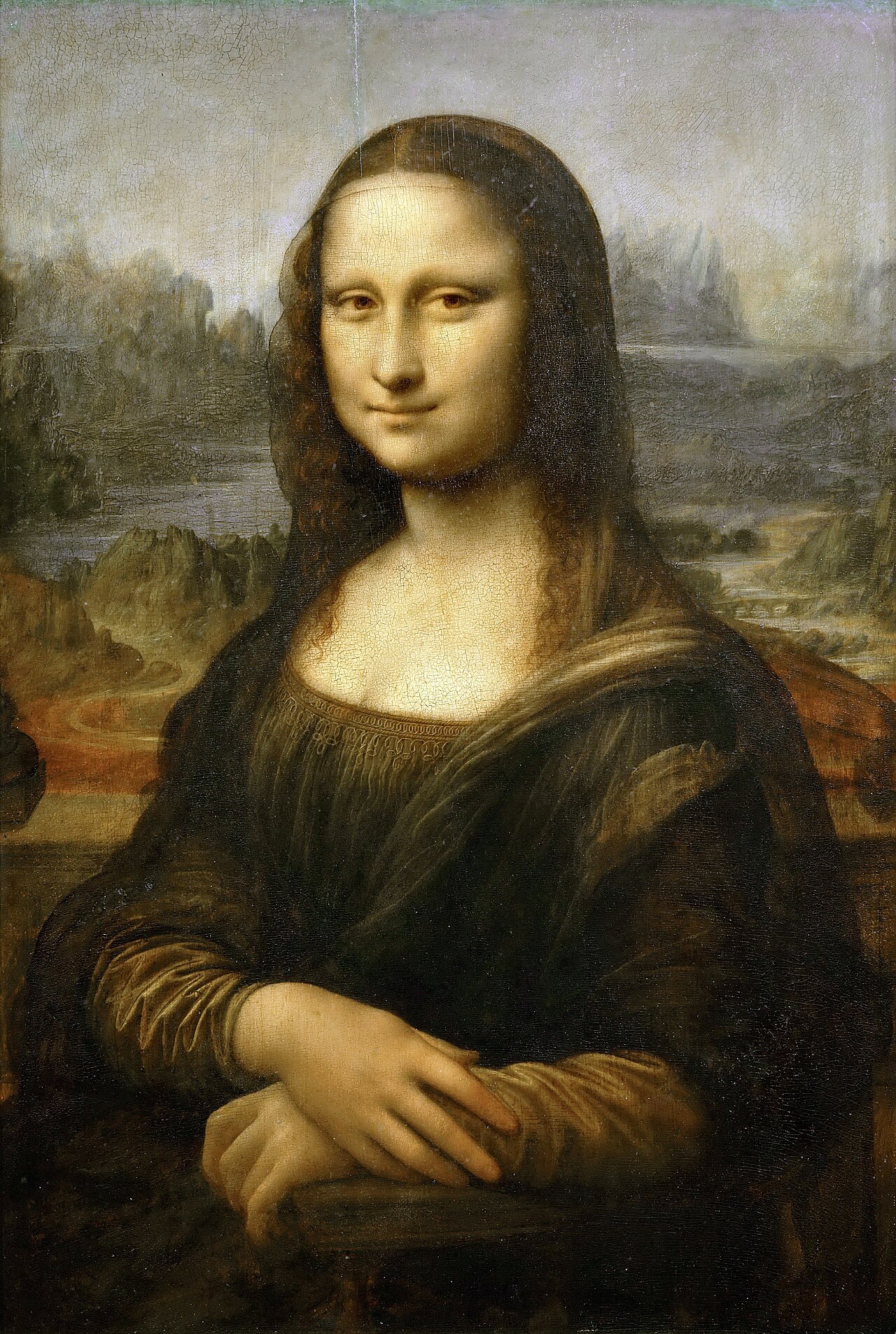
2026 edition Leonardo da Vinci — Mona Lisa (circa 1503-1519), preserved at the Louvre Museum in Paris
50
Painters

From Giotto to Veronese, from Florence to Bruges

Context

What makes these painters essential?

The Renaissance is that moment when Western painting shifts from symbol to reality. Giotto draws volume, Masaccio establishes perspective, Van Eyck observes light with astonishing optical precision, Leonardo da Vinci unites science and poetry in a single smile — and two centuries later, European art will never be the same.

The ranking below combines three criteria: technical innovation (perspective, sfumato, Flemish oil), current museum circulation (Louvre, Uffizi, Prado, National Gallery), and the ability to still speak to us today. Each entry offers a portrait, a signature work, and a direct link to the corresponding collection of reproductions in our shop.

This page is designed as a visitor's guide, not a hit parade. The painters are grouped by schools and generations to make the Florentine, Venetian, Flemish, and German lineages visible. The numbers are indicative — a rank of 28 is not "worse" than a rank of 3; it is simply later or more peripheral.

Italy — Florence, Siena and the Birth (1300-1500)

The Fathers of the Italian Renaissance

It all begins in Florence: Giotto (1267–1337) reintroduces volume and human emotion into Western painting. A century later, Masaccio (1401–1428) establishes linear perspective, and Botticelli (1445–1510) reconciles pagan mythology with Florentine grace. Leonardo da Vinci (1452–1519), Raphael (1483–1520) and Michelangelo (1475–1564) bring this Renaissance to its universal peak.

#1Leonardo da Vinci

1452–1519 · Florentine Republic · High Renaissance

#2Michelangelo

1475–1564 · Florentine Republic · High Renaissance

#3Raphael Sanzio

1483–1520 · Holy Roman Empire · Italian Renaissance
First trained in his father's workshop in Urbino, where his father Giovanni Santi taught him the rudiments of drawing, Raphael Sanzio joined Pietro Perugino's workshop in Perugia at a very young age, absorbing from him the softness of faces and the science of receding architectures. His touch is immediately recognizable in this almost musical clarity of modeling, where flesh seems to breathe under an evenly distributed light, and in his rigorously geometric composition that distributes figures according to invisible pyramids, inherited from Leonardo but tempered with a more human grace. The colors, never aggressive, answer one another in muted echoes: ochres, earths, tender blues, organized into harmonies that leave nothing to chance. His absolute masterpiece remains The School of Athens, painted between 1509 and 1511 in the Stanza della Segnatura in the Vatican, where Plato and Aristotle lead the way in a procession of philosophers arranged like the notes of a score, each finding its rightful place in an architecture aspiring to eternity. The work condenses the ideal of the classical Renaissance: clear thought, the noble body, intelligible space. A central figure of the High Italian Renaissance alongside Leonardo and Michelangelo, Raphael fixed for the centuries to come the canon of a balance where beauty is never the fruit of conflict, but of a carefully orchestrated concord between reason and the senses.
View the Raphael Sanzio collection

#5Sandro Botticelli

1445–1510 · Italy · Early Renaissance

#8Giotto di Bondone

1267–1337 · Italy · Pre-Renaissance

#9Masaccio

1401–1428 · Florentine Republic · Italian Renaissance

#10Piero della Francesca

1415–1492 · Florentine Republic · Early Renaissance

#11Andrea Mantegna

1431–1506 · Republic of Venice · Italian Renaissance

#12Fra Angelico

1400–1455 · Florentine Republic · Italian Renaissance

#22Pietro Perugino

1448–1523 · Italy · Umbrian School

#23Domenico Ghirlandaio

1448–1494 · Florentine Republic · Italian Renaissance

#24Fra Filippo Lippi

1406–1469 · Florentine Republic · Renaissance

#25Paolo Uccello

1397–1475 · Florentine Republic · Renaissance

#26Andrea del Sarto

1487–1530 · Italy · High Renaissance

#34Fra Bartolomeo

1472–1517 · Florentine Republic · Renaissance

#35Benozzo Gozzoli

1420–1497 · Florentine Republic · Italian Renaissance

#42Rosso Fiorentino

1494–1540 · Italy · Mannerism

#43Il Sodoma

1477–1549 · Republic of Siena · Renaissance

#45Andrea del Castagno

1420–1457 · Florentine Republic · Italian Renaissance
Born around 1421, Andrea del Castagno trained in Florence within the orbit of Donatello's sculpture and Masaccio's revolutionary frescoes, possibly working alongside Domenico Veneziano in the Brancacci Chapel workshops. This apprenticeship among sculptors and monumentalists forged his understanding of the body as a volume under tension. His hand sculpts the painted figure with the chisel. He models flesh through violent chiaroscuro, breaks drapery into angular facets that lock the body into space, and twists necks and limbs as if each saint had just received a sentence. Nothing relaxes in his canvases — the muscles clench, the shadows bite, and the gaze of his characters fixes a point beyond the picture, somewhere on the horizon of the inevitable. The Last Supper of Sant'Apollonia (1445-1450) reveals him in full force: Judas recoils in isolation, his face half-eaten by darkness, while Christ advances toward the bread with the solemnity of a condemned man. Across the refectory wall, the apostles lean, doubt, and betray in a single geometry of suspended catastrophe. A mediator between Masaccio's gravity and the nervous energy of later Florentine painting, he died at thirty-six, leaving twelve works that still teach the Renaissance how to sculpt light.
See the Andrea del Castagno collection

#46Piero di Cosimo

1462–1522 · Florentine Republic · Florentine Renaissance

#47Cosimo Tura

1430–1495 · Duchy of Ferrara · Quattrocento

#50Andrea del Verrocchio

1435–1488 · Florentine Republic · Italian Renaissance

Italy — Venice and Color (1450-1580)

The Venetian Splendor and Its Geniuses

Venice counters Florentine rigor with a school of color and light. Giovanni Bellini (1430-1516) establishes the Venetian tradition, Giorgione (1477-1510) invents the tonal landscape, Titian (1488-1576) liberates the brushstroke and the palette. Alongside them, Veronese (1528-1588) and Tintoretto (1518-1594) carry Venetian painting to its flamboyant baroque, a direct transition into the following century.

#4Titian (Tiziano Vecellio)

1488–1576 · Republic of Venice · Venetian School

#13Giovanni Bellini

1430–1516 · Republic of Venice · Renaissance

#18Paul Veronese

1528–1588 · Republic of Venice · Mannerism

#19Jacopo Tintoretto

1518–1594 · Republic of Venice · Mannerism

#20Giorgione

1478–1510 · Republic of Venice · High Renaissance
Trained in Venice in Giovanni Bellini's workshop, Giorgione learned there the patience of glazes and the science of Venetian light before becoming, in barely a decade, the secret master of an entire school. He practiced a vaporous sfumato where contours dissolve in a humid atmosphere, inventing that tonal painting that no longer describes the world but breathes it, and his touch becomes velvety, almost invisible, as if the matter itself refused to betray the subject. His famous The Tempest (c. 1508, Gallerie dell'Accademia) condenses his entire art: a silent flash crosses a slate-colored sky, a woman nurses in a devastated landscape, and no one, to this day, truly knows what the scene means — Giorgione, it seems, knows the end of the story but refuses to spoil it. Dead at thirty-two, perhaps of the plague, he bequeaths to Titian, his supposed pupil, and to all Venetian painting, the power of the unsayable. Dead in 1510 of the plague in Venice before turning thirty-five, he leaves only some ten certain works, but each one invents a new genre: the autonomous landscape, the pastoral scene, the musical conversation. His influence on Titian, and then on all Venetian art, is considerable.
View the Giorgione collection

#21Antonio da Correggio

1489–1534 · Signoria of Correggio · Renaissance
Antonio Allegri, known as Correggio (c. 1489–1534), is one of the great innovators of the Parma school, whose inventions of light and perspective will prepare the Baroque directly. Trained in the circle of Mantegna then influenced by Raphael, he quickly freed himself from any tutelage to develop a sensual and luminous manner all his own. His great domes in Parma — the cathedral (Assumption of the Virgin, 1526–1530) and Saint John the Evangelist — inaugurate large-scale illusionistic trompe-l'œil, which will inspire Correggio, then Lanfranco and Bernini a century later. His Venuses and Ledas, mythological paintings on canvas, possess a carnal sensuality that heralds Titian and Rubens. His clear manner, pearly flesh tones, and compositions in motion make him an essential bridge between the classical Renaissance and the nascent Baroque. He died in Correggio in 1534 in relative poverty, leaving a body of work that will influence all of European painting of the seventeenth and eighteenth centuries, from Watteau to Fragonard. His influence on the Baroque is considerable, and Lanfranco, Domenichino, and Bernini all acknowledge their debt to his visionary domes that make the wall fall away into celestial illusion.
View the Antonio da Correggio collection

#27Parmigianino

1503–1540 · Duchy of Parma · High Renaissance
He learned drawing in the workshop of his uncles Pier Ilario and Michele Mazzola in Parma, before briefly crossing paths with Correggio, from whom he kept a fluid elegance. His technical gesture rests on a deliberate deformation of the body: he lengthens necks, stretches fingers, stretches columns, stretches everything he touches until anatomy becomes almost musical, like a string pulled to the extreme without breaking. The Madonna with the Long Neck, painted c. 1535–1540 and kept at the Uffizi in Florence, perfectly sums up this obsession: the Virgin unfurls a neck of marble and a shoulder that stretches like an endless plain, while a small sleeping Christ floats at her feet, tiny, almost forgotten — no one flinches before this mad geometry. He influenced a whole generation of Mannerists, from Rosso Fiorentino to Bronzino, and definitively established the idea that a painting can be beautiful without being true, paving the way for the style that will dominate Europe until the arrival of Caravaggio. Dead in 1540 at thirty-seven after a wandering life between Rome and Parma, he leaves a refined and fragile body of work, of which the Madonna with the Long Neck (1535, Uffizi) remains one of the most famous manifestos of Tuscan Mannerism for the almost perverse elegance of its figures.
View the Parmigianino collection

#28Pontormo

1494–1556 · Italy · Mannerism
Jacopo Pontormo, whose real name was Jacopo Carucci, grew up in the Florentine workshops of the early 16th century, where he had the luck (and the misfortune) of falling under the spell of Andrea del Sarto, whose lessons he absorbed before twisting them in every direction. His hand rests on a nervous drawing, outlines that vibrate like lute strings, and he dares chromatic chords where fleshy pink collides with acid green, where celestial blue turns almost milky, where every silhouette stretches into a swan's neck to lose its footing more surely. Everything about him breathes suspension: bodies float, drapery weighs nothing anymore, time seems to have stopped in a spiritual held breath — the whole Renaissance catching a slight fever. The Deposition from the Cross in the Capponi Chapel at Santa Felicita, painted around 1525–1528, remains his enigmatic masterpiece: a tangle of adolescent bodies and arms entwined in a funereal round, with no earthly anchor, where the Virgin herself resembles melting wax. Later, his Visitation of 1528–1530 pushes the needle even further, with two women meeting in an almost immaterial surge, as if seized by an invisible wind. A founding Mannerist, he blazed a trail for Bronzino, his devoted pupil, and opened a breach in Florentine classicism whose echo has yet to be fully measured.
View the Pontormo collection

#29Bronzino

1503–1572 · Florentine Republic · Mannerism

#30Luca Signorelli

1450–1523 · Florentine Republic · Sienese school
Luca Signorelli (c. 1445–1523) is one of the great Tuscan masters of the Late Renaissance, whose violent and muscular art directly prefigures Michelangelo. Trained in the orbit of Piero della Francesca, he absorbed the master's geometric rigor before breaking free toward an almost Baroque expressiveness. His frescoes in the San Brizio Chapel at Orvieto (1499–1504) mark a turning point in the history of painting: apocalyptic scenes, muscular bodies, swirling drapery, anatomy in motion. The Fall of the Damned and the Preaching of the Antichrist count among the most violent images of the Renaissance. His style foreshadows Michelangelo in its powerful male figures and its bold foreshortening. He died in Cortona in 1523, leaving a body of work that profoundly marked Tuscan Mannerism, and whose influence is found in Pontormo, Bronzino, and beyond, throughout the 16th-century Florentine school. Ennobled by Pope Alexander VI in 1491, he ran a major workshop in Cortona where he trained his nephew Francesco Signorelli. His muscular nudes and daring foreshortenings make him a direct forerunner of the Michelangelo of the Sistine Chapel.
View the Luca Signorelli collection

#31Antonello da Messina

1430–1479 · Kingdom of Sicily · Early Renaissance
Antonello da Messina (c. 1430–1479) is one of the decisive bridge-builders of the Renaissance: he brought the oil painting technique back from Flanders and introduced it to Naples and then Venice. Probably trained in the workshop of Niccolò Colantonio, he absorbed the optical precision of the Flemish Primitives — but combined it with Italian monumentality and Mediterranean psychology. His portraits are famous for their density: a man seen in three-quarter view, a steely gaze, modeled in translucent layers. The Portrait of a Man (1475, Philadelphia) and the so-called Il Condottiere (Louvre) count among the most beautiful images of the Italian Renaissance. In Venice, where he died after a final visit in 1479, his influence on Giovanni Bellini and the young Venetian school was immediate and profound. He signed his works with a discreet flourish, and their authenticity remains a subject of study for art historians, so widely has his manner been imitated. His Christ at the Column and his St. Jerome in His Study have become milestones in the history of the modern portrait, where precision of detail never excludes psychological depth. Dying in Messina in 1479, he left a brief but foundational body of work for all Venetian art of the following generation.
View the Antonello da Messina collection

#32Lorenzo Lotto

1480–1556 · Republic of Venice · High Renaissance

#33Sebastiano del Piombo

1485–1547 · Republic of Venice · Mannerism

#36Vittore Carpaccio

1465–1526 · Republic of Venice · Venetian Renaissance

#37Gentile Bellini

1429–1507 · Republic of Venice · Venetian Renaissance

#38Cima da Conegliano

1459–1517 · Republic of Venice · Venetian School

#39Jacopo Bassano

1510–1592 · Republic of Venice · Venetian School

#48Carlo Crivelli

1430–1490 · Republic of Venice · Gothic art

The Flanders and the Oil Revolution (1420-1568)

Van Eyck, Van der Weyden, Bosch, and Brueghel

In the Burgundian Netherlands, Jan van Eyck (1390-1441) perfected oil painting and observed reality with an optical precision that rivaled the Italians. Rogier van der Weyden (1400-1464) dramatized the Flemish Pietà. Later, Hieronymus Bosch (1450-1516) invented the nightmarish imaginary, and Pieter Bruegel the Elder (1525-1569) painted peasant life with unparalleled narrative verve.

#6Jan van Eyck

1390–1441 · Southern Netherlands · Flemish Primitives

#14Rogier van der Weyden

1390–1464 · Burgundian Netherlands · Flemish Primitives

#16Hieronymus Bosch

1450–1516 · Northern Netherlands · Flemish Primitives
Hieronymus Bosch, born around 1450 in 's-Hertogenbosch, was trained in his father's van Aken workshop before joining in 1486 the Confraternity of Our Lady, an elite circle of artists and devotees that durably shaped his moral vision of the world. His pictorial grammar rests on meticulous drypoint drawing, inverted perspectives where hell occupies the foreground, and a palette of saturated colors applied in successive glazes to make flesh, scales and demonic outgrowths gleam. He excels at populating his panels with hybrid beings — spoon-demons, bird-fish, walking ears — with an entomologist's precision and a sense of the grotesque bordering on social satire. Among his eighty-four recorded works, The Garden of Earthly Delights, completed around 1510 and held in Madrid, unfolds a dizzying triptych in which humanity slides from paradise to lust and then to eternal punishment, each panel saturated with micro-narratives punishing the flesh and pride. The work condenses his visual pedagogy: beauty as a trap, pleasure as a march toward gehenna. A precursor of Surrealist imagery four centuries before Dalí, Bosch establishes in history a painting in which Christian morality becomes a cabinet of obscure curiosities, influencing Bruegel the Elder, Ensor and all painters of the lucid nightmare down to Bacon.
See the Hieronymus Bosch collection

#17Pieter Bruegel the Elder

1525–1569 · Duchy of Brabant · Flemish Renaissance

Germany and the Northern Renaissance (1450–1550)

Dürer, Holbein and the Rhenish North

Germany imports the Italian Renaissance through engravings and travels (Dürer goes to Venice in 1494–95 and 1505–07). Albrecht Dürer (1471–1528) adds to it a graphic power and a sense of detail that define the Northern school. Hans Holbein the Younger (1497–1543) paints the court of Henry VIII of England with an unmatched psychological realism — two solitary geniuses who sum up Germanic singularity.

#7Albrecht Dürer

1471–1528 · Duchy of Bavaria · German Renaissance

#15Hans Holbein the Younger

1497–1543 · Holy Roman Empire · German Renaissance

The Pioneer Women of the Renaissance (1550-1614)

Sofonisba Anguissola and Lavinia Fontana

The Renaissance is also the story of women painters who managed to emerge despite the considerable obstacles of their time. Sofonisba Anguissola (1532-1625), trained in Cremona, became the official portraitist at the court of Philip II of Spain. Lavinia Fontana (1552-1614), from Bologna, was one of the first women to paint historical and religious subjects with public recognition. Two pioneering careers in a world of male workshops.

#40Sofonisba Anguissola

1531–1625 · Cremona · Mannerism
Sofonisba Anguissola trained in Cremona under Bernardino Campi, then Bernardino Gatti, before meeting Michelangelo in Rome, who, struck by her drawings, encouraged her to study the nude, which he considered indispensable for any serious painter. Her gesture is that of a restrained sfumato, with an almost invisible touch, where light glides over faces without ever forcing the line, revealing in small gray touches the silent intelligence of her models. She seeks less flattery than psychological presence, placing her subjects in a bare space that forces the eye to linger on what unfolds in a gaze or a half-smile. In her Portrait of Her Sisters Playing Chess, painted in 1555, Anguissola stages Minerva and Europa absorbed by the game, translating the intellectual concentration of the young girls with an almost mathematical rigor that already foreshadows Lombard naturalism. The work, praised by Vasari, reveals that discreet modernity that consists in giving women a serious, almost philosophical subject, rather than a simple pose of vanity. At the court of Philip II, she became the official portraitist and painted four queens of Spain, imposing in official art a presence of the models that is in no way ornamental. A pupil of Michelangelo and a master of van Dyck, Anguissola holds a singular place: she proves that a woman can excel in the grand genre, and her work, long eclipsed, today appears as one of the pillars of late Renaissance psychological portraiture.
See the Sofonisba Anguissola collection

#41Lavinia Fontana

1552–1614 · Italy · Mannerism

Late Mannerism (1520–1600)

Between grace and strangeness

After the High Renaissance, the Mannerist generation sought to surpass Raphael and Michelangelo through elegance, strangeness, and formal sophistication. Parmigianino (1503–1540) elongated bodies, Pontormo (1494–1557) dissolved contours in fluid colors, Bronzino (1503–1572) imposed an aristocratic coldness. This is the Florentine school between 1520 and 1560, a transition toward the Baroque.

#44Domenico Veneziano

1410–1461 · Republic of Venice · Italian Renaissance

#49Gentile da Fabriano

1370–1427 · Republic of Venice · Italian International Gothic

Bring a little of that light into your home

The Renaissance transformed Western painting: perspective, light, humanity. A quality reproduction, placed in the right spot, is enough to bring that revolution into your home: the Mona Lisa in an office, the Last Supper above a fireplace, the Birth of Venus in a bedroom. All the works in this Top 50 are available as canvas reproductions in our collection — with particular care given to color fidelity and original formats.

0 comments

Leave a comment

Please note that comments must be approved before they are published.