

Top 100 - Claude Monet
Claude Monet’s 100 Best-Known Paintings
Impression, Sunrise, Water Lilies, Poppies, The Magpie: discover 100 paintings by Claude Monet, with their context, differences and sources for identifying them.
This editorial selection connects early portraits and landscapes with views of Argenteuil, the series and the garden at Giverny. Each entry describes the image shown and specifies confirmed information; approximate dates and unverified collections are identified.
Light changes position
Which paintings by Monet should you examine to understand his work?
Begin with Impression, Sunrise to observe the harbour of Le Havre and the role of colour, then compare the Water Lilies in Kurashiki and those in London. Poppies and The Magpie show two ways of building a landscape through contrasts. To explore the series, compare the Haystacks, the Four Trees and Rouen Cathedral.
The numbers make navigation easier: they do not measure the works’ value or popularity. Dimensions refer to the originals; reproduction links lead to the sizes offered separately.
Browse the 100 paintingsLooking for a Monet for your home?
Discover our selection for a living room, bedroom, large wall or floral décor.

For a living room
Terrace at Sainte-Adresse
A bright seascape and touches of red to bring rhythm to a living room in light tones.
View sizes and order →
For a bedroom
Water Lilies — National Gallery
Reflections and shades of blue and green to complement a bedroom with a gentle atmosphere.
View sizes and order →
For a large wall
The Water-Lily Pond — Folkwang
An expanse of water and vegetation to consider in a large format. Compare the available sizes with your wall and viewing distance.
View sizes and order →
For floral décor
Chrysanthemums
A richly coloured bouquet to echo the room’s natural materials and colourful accents.
View sizes and order →Unsure about the painting, size or frame? Consult our guide Decorating with Monet or explore Décor & atmosphere to choose according to your room or professional project.
The selected works
The works in pictures
Impression, Sunrise, Water Lilies, women in the wind and landscapes that have become universally recognised open the journey.

#1
Claude Monet1. Impression, Sunrise
From a room at the Hôtel de l’Amirauté in Le Havre, Monet paints the outer harbour at daybreak during a stay dated to around November 1872 by the Musée Marmottan Monet. Cranes, chimneys and masts merge into the mist; boats and the orange sun punctuate the atmosphere. Compare the sun’s disc with its reflection: a few brushstrokes are enough to organise the light. Shown at the first Impressionist exhibition in 1874, the canvas inspires the title of Louis Leroy’s satirical review, ‘The Exhibition of the Impressionists’. This 50 × 65 cm oil painting enters the museum through the Donop de Monchy donation in 1940.
Official museum catalogue entry
Order a reproduction of this painting →
#2
Claude Monet2. Water Lilies — Ohara Museum
These Water Lilies belong to the Ohara Museum in Kurashiki, Japan. The museum dates them to around 1906 and lists an oil on canvas measuring 73 × 92.5 cm in its June 2021 bulletin. Floating leaves and flowers mingle with reflections: notice how the touches of colour leave you wavering between the pond’s surface and the water’s depth. This relatively intimate version invites comparison with the large National Gallery canvas presented next. The same subject thus produces very different compositions and viewing experiences.
View the museum catalogue entry → #3
Claude Monet3. Water Lilies — National Gallery
This large 200.7 × 426.7 cm canvas belongs to the monumental Water Lilies painted after 1916, when Monet has a new studio at Giverny. The horizon disappears: water fills the entire field and leaves float towards the edges. Observe the central space, where streaks of colour leave you wavering between reflections of the sky, clouds or willows. The National Gallery describes this absence of reference points as an immersive experience. The work remains at Giverny after the painter’s death, then is purchased by the London museum in 1963. Its number, NG6343, distinguishes it from the panels installed at the Orangerie.
Official museum catalogue entry
Order a reproduction of this painting →
#4
Claude Monet4. Study of a Figure Outdoors: Woman with a Parasol Facing Left
Monet paints this Woman with a Parasol in 1886. The Orsay catalogue identifies the model as Suzanne Hoschédé, Alice Hoschédé’s daughter. The figure facing left, the parasol and the clouds form a study of a figure outdoors: compare the direction of her face and the diagonals with the movements of the sky. The work measures 131 × 88.7 cm and bears the number RF 2621. Michel Monet, the painter’s son, donates it to the French state in 1927; it is assigned to the Musée d’Orsay in 1986. These details distinguish it from Monet’s other women with parasols.
Order a reproduction of this painting →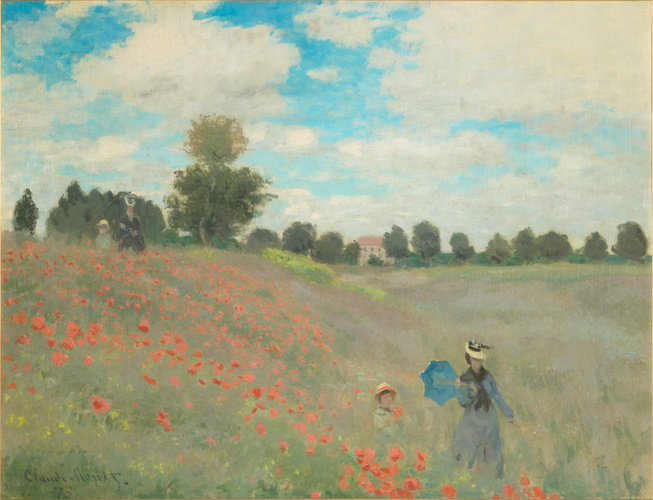
#5
Claude Monet5. Poppies
Painted in 1873 during Monet’s years in Argenteuil, Poppies is shown at the first Impressionist exhibition in 1874. Two groups, each consisting of a woman and a child, create a diagonal across the field. The museum tentatively identifies Camille and Jean Monet in the foreground. Observe the broad red touches of the flowers and the loosely defined outlines: the walk becomes a sensation of light and colour. This 50 × 65.3 cm oil on canvas enters the national collections through Étienne Moreau-Nélaton’s donation in 1906.
Image © GrandPalaisRmn (Musée d’Orsay) / Hervé Lewandowski.
View the museum catalogue entry →
#6
Claude Monet6. The Magpie
Monet paints The Magpie near Étretat during the winter of 1868–1869. The bird perched on the gate provides a small dark point amid the snowy landscape. Pay particular attention to the shadows: the snow takes on coloured hues, while the sunlit areas appear warmer. White thus becomes a luminous substance rather than a uniform surface. According to the Musée d’Orsay, this choice of light tones contributes to the painting’s rejection from the Salon of 1869. This 89 × 130 cm oil on canvas is acquired for the museum in 1984. The scene transforms an ordinary rural motif into an investigation of light.
Official Musée d’Orsay catalogue entry
Order a reproduction of this painting →
#7
Claude Monet7. Saint-Lazare Station, Arrival of the Normandy Train
The illustrated canvas is Arrival of the Normandy Train, Gare Saint-Lazare, held in Chicago. Monet places a locomotive on the right, beneath a glass roof whose framework disappears into billows of steam. The central lamppost echoes the roof’s peak and organises this scene, animated by small figures. Shown at the third Impressionist exhibition in April 1877 with six other views of the station, this painting turns the railway into a subject of light and movement. Observe the contrast between the dark machines and the blue-grey clouds: it conveys industrial activity without detailing every traveller.
Official Art Institute of Chicago catalogue entry
Order a reproduction of this painting →
#8
Claude Monet8. The Houses of Parliament, London
This version of The Houses of Parliament, London, held at the Art Institute of Chicago, brings Westminster out of a blue and green mist punctuated with pink. The great tower and spires stand out against the sky, while a small boat in the foreground gives the landscape a sense of scale. Look at the horizontal brushstrokes of the Thames: they echo the palace’s vertical lines. The museum’s technical study reveals that Monet reworked the tower, boat and water after the first layers had dried. The fleeting appearance of the light therefore also results from patient layering, characteristic of this canvas dated 1900–1901.
Catalogue entry and technical study from the Art Institute of Chicago
Order a reproduction of this painting →
#9
Claude Monet9. Rouen Cathedral, the Portal Seen from the Front (Brown Harmony)
This Brown Harmony frames the portal of Rouen Cathedral head-on, its reliefs filling almost the entire canvas. The stone becomes a network of brushstrokes and shadows: look at how the portal’s recesses contrast with its projecting features rather than seeking an exact architectural record. The Musée d’Orsay dates the work to 1892, although the signature bears ‘94’; these two indications should not be confused. Shown at Durand-Ruel’s in 1895, it was purchased directly from Monet by the French state in 1907. Its subtitle distinguishes it from the other cathedrals in the series.
Official Musée d’Orsay catalogue entry
Order a reproduction of this painting →
#10
Claude Monet10. The Japanese Bridge
This Japanese Bridge belongs to the late paintings of the garden at Giverny. The illustrated version, held at the Musée Marmottan Monet under number 5091, is dated between 1918 and 1924. The bridge can be made out amid dense vegetation: its dark curve crosses red, green and purple brushstrokes that mingle foliage, water and reflections. To find the motif, follow this curve, then look at the movements of colour beneath the arch. The composition shows how Monet can transform a familiar place into an almost abstract experience. Unsigned, the canvas entered the museum with his son Michel’s bequest in 1966.
Official Musée Marmottan Monet catalogue entry
Order a reproduction of this painting →
#11
Claude Monet11. Garden at Sainte-Adresse (Terrace at Sainte-Adresse)
Monet paints this Garden at Sainte-Adresse during the summer of 1867, near Le Havre, using members of his family as models; his father is seated wearing a Panama hat. The elevated viewpoint divides the flower-filled terrace, sea and sky into three bands crossed by flagpoles. This structure emphasises the painting’s surface and reflects Monet’s interest in Japanese prints. Look at the contrast between the flowers in the foreground and the small sailing boats in the distance. The work was shown in 1879 at the fourth Impressionist exhibition before entering the Metropolitan Museum in 1967.
Official Metropolitan Museum of Art catalogue entry
Order a reproduction of this painting →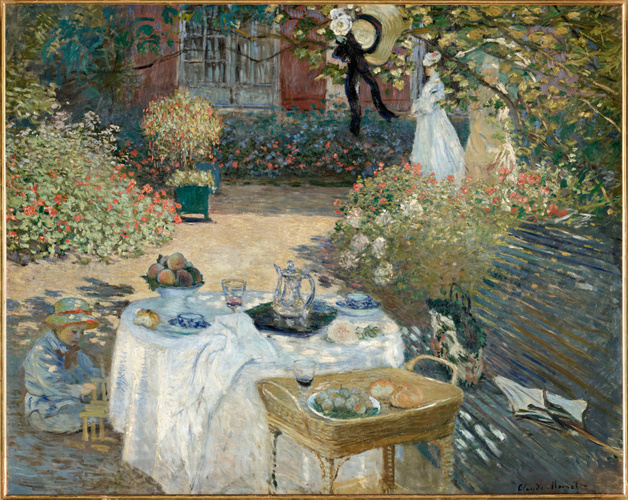
#12
Claude Monet12. The Luncheon, Decorative Panel
In this Luncheon painted around 1873, the table still laid, the hanging hat and the parasol left on a bench evoke family life after the meal. Young Jean Monet plays with small wooden boards beneath the foliage. Look at the wicker trolley, cut off by the lower edge: this framing brings the objects closer to the viewer and contrasts with the woman at the far end of the garden. Despite its intimate subject, the canvas is more than two metres wide. Monet exhibits it as a ‘decorative panel’ in 1876; Gustave Caillebotte buys it in 1878, and his bequest brings the work into the national collections in 1896.
Official Musée d’Orsay catalogue entry
View the museum catalogue entry →
#13
Claude Monet13. Camille on Her Deathbed
Monet paints his first wife, Camille Doncieux, on her deathbed in 1879. Her face appears amid long blue and violet brushstrokes that cross the sheets and veil: observe how her features remain discernible within this shifting paint. This final portrait combines a deeply intimate subject with the painter’s attention to colour and light. It contrasts with his depictions of Camille in the garden or on a walk. Initially kept by his son Michel, the canvas enters the national collections through Katia Granoff’s donation in 1963, then is assigned to the Musée d’Orsay in 1986.
Official Musée d’Orsay catalogue entry
Order a reproduction of this painting →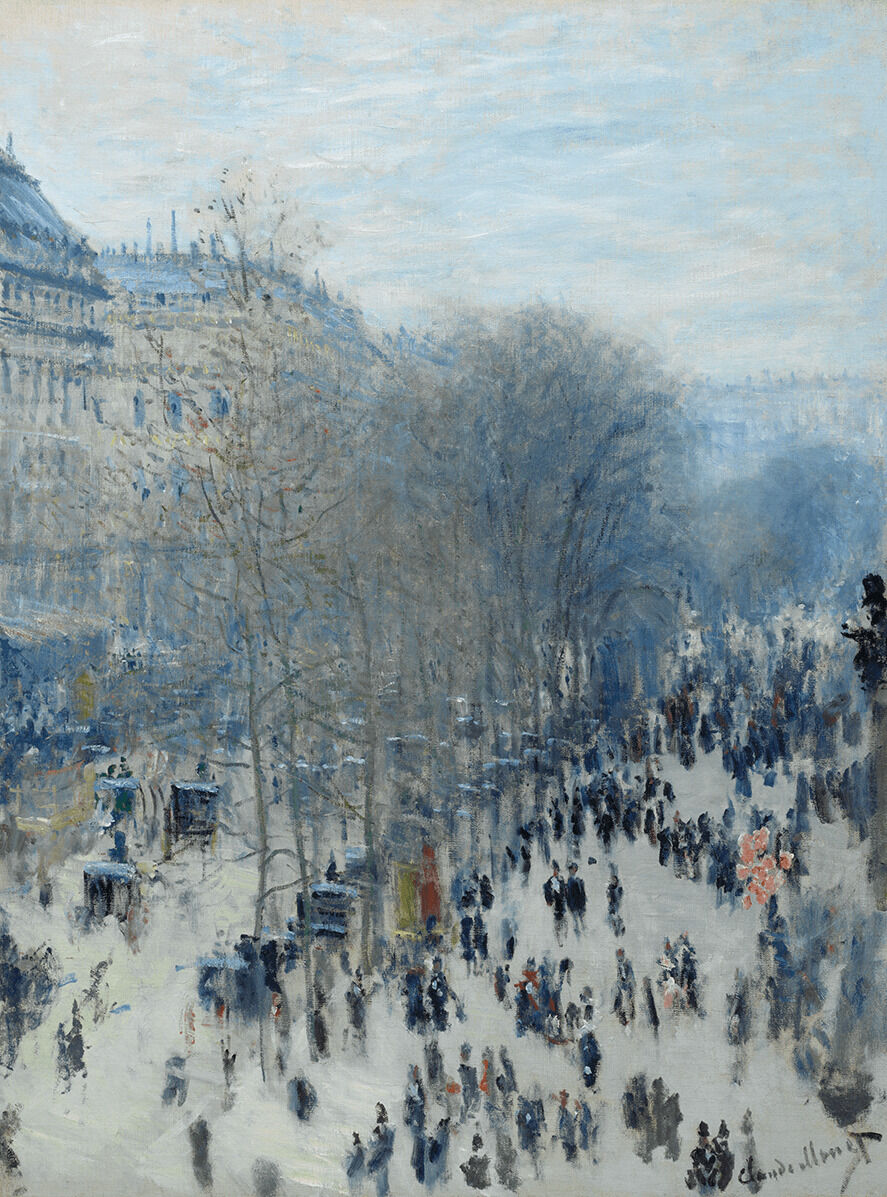
#14
Claude Monet14. Boulevard des Capucines
Monet observes the boulevard from the upper floors of 35 Boulevard des Capucines, the photographer Nadar’s former studio, in late 1873 or early 1874. In this vertical version, held at the Nelson-Atkins Museum of Art, the street stretches into the distance between façades and bare trees. Passers-by are reduced to dark brushstrokes, precise enough to suggest a moving crowd. Look at the contrast between these figures and the blue-grey atmosphere enveloping Paris. Monet also paints a horizontal version, now in Moscow: the museum catalogue distinguishes that second canvas, shown at the Impressionist exhibition of 1874, from the one illustrated here.
Official Nelson-Atkins Museum of Art catalogue
View the museum catalogue entry →
#15
Claude Monet15. Haystacks (Wildenstein 1273)
This version of the Haystacks, held at the Museum Barberini in Potsdam, belongs to the twenty-five paintings made around Giverny in 1890–1891. They depict bundles of unthreshed grain protected from the weather by a covering of straw or hay. Their alignment leads the eye diagonally into the distance, while the sun’s rays cross that direction. Observe the luminous edge of the large stack and the violet shadows: the backlighting transforms an agricultural motif into an experience of colour. The museum dates the canvas to 1890, but its signature bears ‘91’. The number Wildenstein 1273 identifies this particular version.
Official Museum Barberini catalogue entry
Order a reproduction of this painting →
#16
Claude Monet16. Regatta at Argenteuil
Argenteuil’s sailing boats offer Monet a subject of modern leisure as well as a study of light. Living in this town from December 1871 to 1878, he paints the pale sails and riverside houses reflected in the Seine. Look at the difference between the upright forms above the water and their reflections broken into horizontal brushstrokes: this contrast conveys the river’s shifting surface. The breadth of the Argenteuil basin encouraged boat races, attracting competitors and visitors who travelled from Paris by train. Dated to around 1872 by Orsay, the canvas enters the national collections with the Caillebotte bequest in 1896.
Official Musée d’Orsay catalogue entry
View the museum catalogue entry →

#17
Claude Monet17. Doctor Leclenché
This small portrait depicts Monet’s physician, identified as Doctor Leclenché by his son Michel. Seated with his legs crossed, the sitter holds a cigar in his left hand and adopts a relaxed pose. Look at how the light trousers, hands and face stand out against the dark suit and brown background: these contrasts give the figure his presence. Painted in 1864, while Monet is still developing his portrait practice, the painting retains something of his beginnings as a caricaturist in its slightly exaggerated gestures. It joins the Metropolitan Museum through the gift of Mr and Mrs Edwin C. Vogel in 1951.
Official Metropolitan Museum of Art catalogue entry
View the museum catalogue entry →
#18
Claude Monet18. Child with a Cup, Portrait of Jean Monet
Jean, Claude Monet and Camille Doncieux’s first son, poses beside a blue and white cup in this portrait of 1868. The framing brings the child’s face close to the vessel in the foreground, while the brown background highlights his skin and light clothing. Look at the broad brushstrokes in the hair and sleeves: they lend vitality to a very simple domestic scene. The Auctionata catalogue of December 2016 places its execution in Étretat and cites the number Wildenstein 131. This source documents the canvas and its sale history; it does not establish its current location.
Auctionata sale catalogue, December 2016, via Invaluable
Order a reproduction of this painting →
#19
Claude Monet19. The Water-Lily Pond and the Japanese Bridge
The illustrated version is the Bridge over a Pond of Water Lilies at the Metropolitan Museum, painted in 1899. Monet developed his water garden after purchasing land at Giverny in 1893; he thus finds his subjects within a landscape he created himself. The vertical format gives ample space to the floating flowers and reflections beneath the bridge. Look at the water: it shows the water lilies on its surface, reflected trees and the shadow of the arch at the bottom of the canvas simultaneously. Completed during the summer of 1899, this painting joins the Met through Louisine Havemeyer’s bequest in 1929.
Official Metropolitan Museum of Art catalogue entry
Order a reproduction of this painting →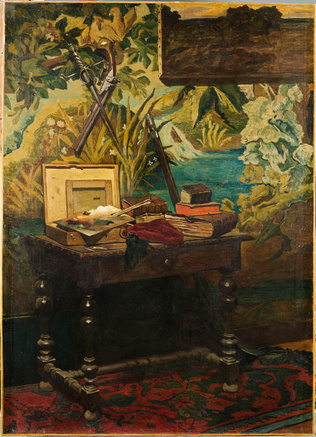
#20
Claude Monet20. A Corner of the Studio
In A Corner of the Studio, Monet paints a collection of objects rather than a person: books, painting equipment and weapons gather on a piece of furniture against an elaborate backdrop. Look at the contrasts between the pale objects, dark wood and red carpet; they organise this large still life from his youth. Dated 1861 and signed ‘O. Monet. 61’, the canvas predates his famous Impressionist investigations of landscape. Held at Orsay under number MNR 136, it has a particular status: recovered in Germany after the Second World War, it is entrusted to the care of the national museums in 1950, then assigned to Orsay in 1986.
Official Musée d’Orsay catalogue entry
View the museum catalogue entry →
#21
Claude Monet21. The Green Wave
In The Green Wave, a sailing boat heels over amid rough seas, while other vessels appear near the horizon. Monet leaves little room for the sky: this high horizon gives the dark water and white foam their full force. Look at the diagonals of the hull and sails, which heighten the boat’s instability. The Metropolitan Museum dates this seascape to around 1866–1867 and compares its composition with Manet’s naval scenes, which Monet may have seen exhibited in Paris. The canvas joins the museum with Louisine Havemeyer’s bequest in 1929; it reveals a more dramatic aspect of his early explorations of the sea.
Official Metropolitan Museum of Art catalogue entry
Order a reproduction of this painting →
#22
Claude Monet22. Portrait of Adolphe Monet
Adolphe Monet is depicted from the chest up, turned to the left, against a plain olive-brown background. His round glasses, beard and pronounced eyebrows focus attention on his face; the white collar brightens an almost black suit. This framing gives the sitter a restrained presence without narrative accessories. MuMa distinguishes two individual portraits of Monet’s father painted in 1865: a smaller version acquired by Léon Monet, and this larger, more fully developed version, initially kept by Claude and later held at the Zimmerli Art Museum. This distinction avoids attributing the dimensions or provenance of the privately owned painting to it.
Source: MuMa, Monet in Le Havre: the two portraits of Adolphe Monet. Image: Wikimedia Commons, reproduction of the portrait at the Zimmerli Art Museum.
View the museum reference →
#23
Claude Monet23. Portrait of Jean Monet
Monet depicts Jean from the chest up against a light grey background that leaves all the emphasis on his face. Dark hair and deep blue clothing frame the luminous skin; the white collar draws the eye towards his head. Visible brushstrokes give the portrait a lively presence without detailing every feature. This image of Jean as an adolescent differs from the portrait of the child with a cup presented above. Signed and dated 1880 at the lower right, this oil on canvas measures 47 × 38 cm. It entered the Musée Marmottan Monet through Michel Monet’s bequest in 1966.
Source: Musée Marmottan Monet catalogue entry, inventory 5021
Order a reproduction of this painting →
#24
Claude Monet24. Self-Portrait
In this late self-portrait, Monet concentrates the painting on his head and beard, surrounded by a background largely left light. Pink and violet brushstrokes in the face echo the yellows and greens in the beard; the dark areas of clothing and hair frame this light. His lowered gaze and close framing give the image an intimate character. Painted in 1917, this 70.5 × 55 cm oil on canvas belongs to the Musée d’Orsay’s collections under number RF 2623. Georges Clemenceau donated it to the French state in 1927, a year after the painter’s death.
Source: Musée d’Orsay catalogue entry, RF 2623
Order a reproduction of this painting →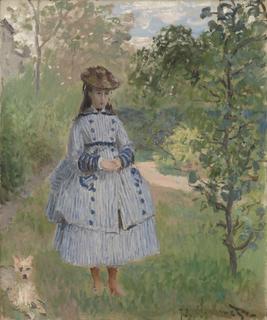
#25
Claude Monet25. Portrait of Mademoiselle Bonnet
The Barnes Foundation presents this 1873 painting under the title Girl with Dog, ‘Girl with a Dog’. The young girl stands in a garden, her hands held together in front of her striped dress; a small dog appears beside her at the lower left. Rapid brushstrokes in the vegetation and fur enliven the scene, while the carefully described outfit anchors the portrait in the fashions of its time. According to the foundation, Monet probably painted it in Argenteuil. The work’s interest lies in this meeting of portraiture and outdoor painting, a year before the first Impressionist exhibition.
Source: Barnes Foundation catalogue ; the foundation’s commentary on the work.
View the museum catalogue entry →Bridges, trains, gardens and leisure activities tell the story of an era discovering speed without giving up luncheon on the grass.

#26
Claude Monet26. View of a Port
The boats in the foreground lead the eye towards the large ships and their smoke, which crosses the sky diagonally. Monet contrasts slender masts and dark hulls with pale water enlivened by green and grey brushstrokes. The port thus becomes a landscape of light as much as a place of activity. The Christie’s catalogue dates this canvas to 1871, lists it under number Wildenstein 169 and gives its dimensions as 49.8 × 65 cm. Its provenance mentions Durand-Ruel, followed by several private collections. The private collection indicated refers to the 2015 sale; it does not establish where the work is today.
Source: Christie’s catalogue, View of a Port, 2015
Order a reproduction of this painting →
#27
Claude Monet27. Portrait of Michel Monet as a Baby
The white bonnet and its ribbon form a luminous frame around the face of Michel, the painter’s second son. Pink cheeks and red hair stand out against a dark background, while the white brushstrokes of the collar contrast with the violet clothing. His gaze turned to the left avoids the stiffness of a frontal pose: Monet captures the child’s presence with lively paintwork whose brushstrokes remain visible. The Musée Marmottan Monet’s catalogue entry dates this unsigned canvas to between 1878 and 1879. Measuring 46 × 37 cm, it entered the museum’s collections through Michel Monet’s bequest in 1966.
Source: Musée Marmottan Monet catalogue entry, inventory 5014
Order a reproduction of this painting →
#28
Claude Monet28. Landscape. Vétheuil
The Seine occupies the left of the painting, while a grassy bank and a tree open up the foreground on the right. Beyond the water, Vétheuil’s houses and church tower stand out against the hills. Monet links these planes through a range of greens and yellows beneath a sky enlivened by pale clouds. The eye thus moves from the detail of the grasses to an overall view of the village. Signed and dated 1879, this 60 × 73.5 cm canvas appears in the history of the fourth Impressionist exhibition. It has belonged to the Musée d’Orsay since 1986, following Étienne Moreau-Nélaton’s bequest to the French state in 1927.
Source: Musée d’Orsay catalogue entry, RF 2639
Order a reproduction of this painting →
#29
Claude Monet29. The Studio Boat
The boat’s green cabin is reflected in calm water amid reflections of the sky and trees. Two poles hold the vessel still; a figure can be made out in the opening, probably Monet according to the museum. The contrast between the clear forms of the floating studio and their fragmented reflections gives the painting its rhythm. Living in Argenteuil, Monet had fitted out this boat to paint from the Seine, following Daubigny’s example. This 1874 version, held at the Kröller-Müller Museum, measures 50.2 × 65.5 cm. It differs from the Studio Boat of 1876 at the Barnes Foundation, which has a vertical format.
Source: Kröller-Müller Museum catalogue entry, KM 111.222
Order a reproduction of this painting →
#30
Claude Monet30. Wave Effect at Étretat
The waves occupy most of the foreground and break at the foot of the cliff. Monet juxtaposes blue, green and white brushstrokes to convey the water’s movement; the rock, painted in pink and ochre tones, forms a more stable mass on the right. The cloudy sky continues the colours of the sea, while the foam traces a luminous diagonal towards the shore. The painting’s interest lies in this contrast between the permanence of the cliff and the constant renewal of the waves. Tokyo’s Matsuoka Museum of Art confirms the date of 1883 and presented the work in its 2023 exhibition devoted to Monet, Renoir and Impressionist light.
Source: Matsuoka Museum of Art, presentation of the 2023 exhibition
Order a reproduction of this painting →
#31
Claude Monet31. The Port of Le Havre, Night Effect
In the port, almost entirely immersed in dark blues, small white, red and green lights extend into reflections on the water. Masts and hulls are suggested rather than clearly defined. Monet studies artificial lighting here: the row of white points corresponds to the gas lanterns installed on the quays from 1869 onwards. The Museum Barberini presents this 60 × 81 cm canvas as the nocturnal counterpart to Impression, Sunrise, painted from the same viewpoint. It gives the date as 1872 and explains that the 1873 date in the Wildenstein catalogue is incorrect.
Source: Museum Barberini catalogue, MB-Mon-04
View the museum catalogue entry →
#32
Claude Monet32. Portrait of Bazille
Bazille appears in profile, seated near a window whose light leaves his face in shadow. His pale shirt contrasts with his hair, beard and the dark garment over his shoulders; the landscape visible behind him opens the composition towards the outdoors. This small portrait reflects the closeness of the two young painters, who work in Honfleur and frequent the Saint-Siméon farm in 1864. Long attributed to Bazille himself, the painting was reassigned to Monet through the research mentioned in the Musée Fabre’s catalogue entry. This 40.5 × 31.5 cm oil on wood was donated to the museum by the Bazille family in 1945.
Source: Musée Fabre catalogue entry, inventory 45.8.1
Order a reproduction of this painting →
#33
Claude Monet33. Leicester Square at Night
The lights of Leicester Square dissolve into yellow, orange and green brushstrokes in a grey and violet atmosphere. Buildings and passers-by become difficult to distinguish: Monet prioritises the luminous vibration of the London square. The Musée Granet guide places this 1901 canvas within a group of three nocturnal studies and specifies that Michel Monet gave it to Jean Planque. It measures 80.5 × 64.8 cm and belongs to the Fondation Jean et Suzanne Planque. Presented in the Granet XXe resources, it also appears in the announcement of the Musée Jenisch in Vevey’s exhibition scheduled from 6 November 2026 to 18 April 2027.
Source: Musée Granet, Planque Collection ; visitor guide ; exhibition announced at the Musée Jenisch.
Order a reproduction of this painting →
#34
Claude Monet34. Portrait of Poly
A broad dark hat and beard frame Poly’s face, his gaze turned slightly to one side. Against the pale background, Monet models his features with red, pink and grey brushstrokes; strokes across the blue clothing give the bust its presence. The composition thus focuses attention on the sitter without a narrative setting. The inscription at the upper right, ‘Claude Monet Belle Isle 86’, directly links the portrait to the painter’s stay on Belle-Île in 1886. This 74 × 53 cm oil on canvas is held at the Musée Marmottan Monet, which it entered through Michel Monet’s bequest in 1966.
Source: Musée Marmottan Monet catalogue entry, inventory 5023
Order a reproduction of this painting →
#35
Claude Monet35. View of Vernon
A pale path crosses the foreground before green fields, while slender trees punctuate the view towards Vernon. The church rises above the houses and distant hills beneath a grey sky. Monet’s broken brushstrokes convey variations in light without detailing every element of the landscape. The Chrysler Museum of Art’s catalogue entry associates the overcast sky and sparsely leafed trees with early spring. Painted in 1886 near Giverny, where Monet had settled in 1883, this oil on canvas measures 60.3 × 79.4 cm. It belongs to the Norfolk museum under number 71.721, through a gift from Walter P. Chrysler Jr.
Source: Chrysler Museum of Art catalogue entry on Google Arts & Culture
Order a reproduction of this painting →
#36
Claude Monet36. Self-Portrait Wearing a Beret
Monet depicts himself from the chest up, wearing a black beret, with a dark beard and grey coat. The pale background highlights his head and gaze directed towards the viewer; visible brushstrokes in the clothing give the image a loose handling. The Jordan Schnitzer Museum of Art guide dates this self-portrait to 1886, when the painter is living in Giverny. This portrait from his mature years invites comparison with his image in the late self-portrait of 1917 presented above. The museum exhibited it from 2 February to 8 May 2022 as a loan from a private collection: this display does not mean that the work belongs to its collections.
Source: Jordan Schnitzer Museum of Art research guide, p. 4
Order a reproduction of this painting →
#37
Claude Monet37. Coastal Landscape
Painted around 1864, this landscape belongs to Claude Monet’s early years. The eye moves from the dense vegetation in the foreground to the sea, then to the vast blue sky crossed by clouds. Trees frame the view without enclosing its horizon. The Van Gogh Museum catalogue sees it as a transition between Barbizon landscape painting and a lighter palette accompanied by freer brushwork. Monet returns to this elevated viewpoint in his landscapes of Argenteuil and later Antibes. The canvas, signed ‘C. Monet’ at the lower right, is held at the Van Gogh Museum in Amsterdam.
Source: Van Gogh Museum Journal 1996, acquisitions catalogue
Order a reproduction of this painting →
#38
Claude Monet38. The Needle Seen through the Porte d’Aval
In this view of Étretat, the cliff occupies almost the entire foreground: its arch reveals the Needle, isolated within a luminous opening. The rock’s dark tones contrast with the pinkish sky and pale reflections of the sea. The National Gallery of Canada tentatively dates the beginning of the work to late 1885, during Monet’s stay on the Normandy coast. The artist then continues the canvas at Giverny and signs it in 1886. The light suggests late afternoon, with the sun passing behind the cliff. This version entered the museum through the gift of the Marjorie and Gerald Bronfman Collection in 2009.
Source: National Gallery of Canada, catalogue entry 43002
Order a reproduction of this painting →
#39
Claude Monet39. Norwegian Landscape. The Blue Houses
Monet paints this landscape during his winter journey to Norway in 1895. Two houses with snow-covered roofs occupy the centre of a vast expanse of snow beneath a yellow and pink sky. Blue shadows and pinkish brushstrokes show that, for Monet, snow is more than white: it takes on the colours of the light. The buildings give a sense of scale to this landscape almost devoid of figures. Staying at Björnegaard, near Sandviken, the painter explores winter’s changing effects while contending with the thaw. This canvas belongs to Michel Monet’s bequest received by the Musée Marmottan Monet in 1966.
Source: Musée Marmottan Monet, catalogue entry 5169 · Context: Claude Monet’s House and Gardens, journey to Norway
Order a reproduction of this painting →
#40
Claude Monet40. Portrait of André Lauvray
Monet paints this portrait in Vétheuil during the summer of 1880. André is the son of Pierre-Abel Lauvray, a notary in Les Andelys; according to the Sotheby’s catalogue, the 150-franc commission accompanies the painter’s request for legal advice. The child’s face, blue eyes and blond curls stand out against a loosely detailed grey background. Visible brushstrokes in the hair and pale clothing bring movement to this bust-length pose. The framing recalls the family portraits Monet paints at the same time. Signed and dated at the lower left, the canvas is documented in Sotheby’s 2018 sale catalogue; its current location is not specified here.
Source: Sotheby’s, sale catalogue of 13 November 2018, lot 428
Order a reproduction of this painting →
#41
Claude Monet41. Landscape with Factories
This small landscape belongs to Monet’s early works. The Gallery 19C catalogue dates it approximately to 1858–1861 and lists it under number 5a in the Wildenstein catalogue raisonné. Sparsely leafed trees stand before a strip of dark buildings; the cloudy sky occupies much of the panel. Greens, browns and greys create a muted atmosphere, very different from the luminous colours of the later paintings. The title associates the landscape with industry without enabling a specific factory to be identified here. The dating remains approximate, and the catalogue notes a signature added later: it therefore does not, on its own, provide a date.
Source: Gallery 19C, Landscape–Factories, Wildenstein reference 5a
View the reference catalogue entry →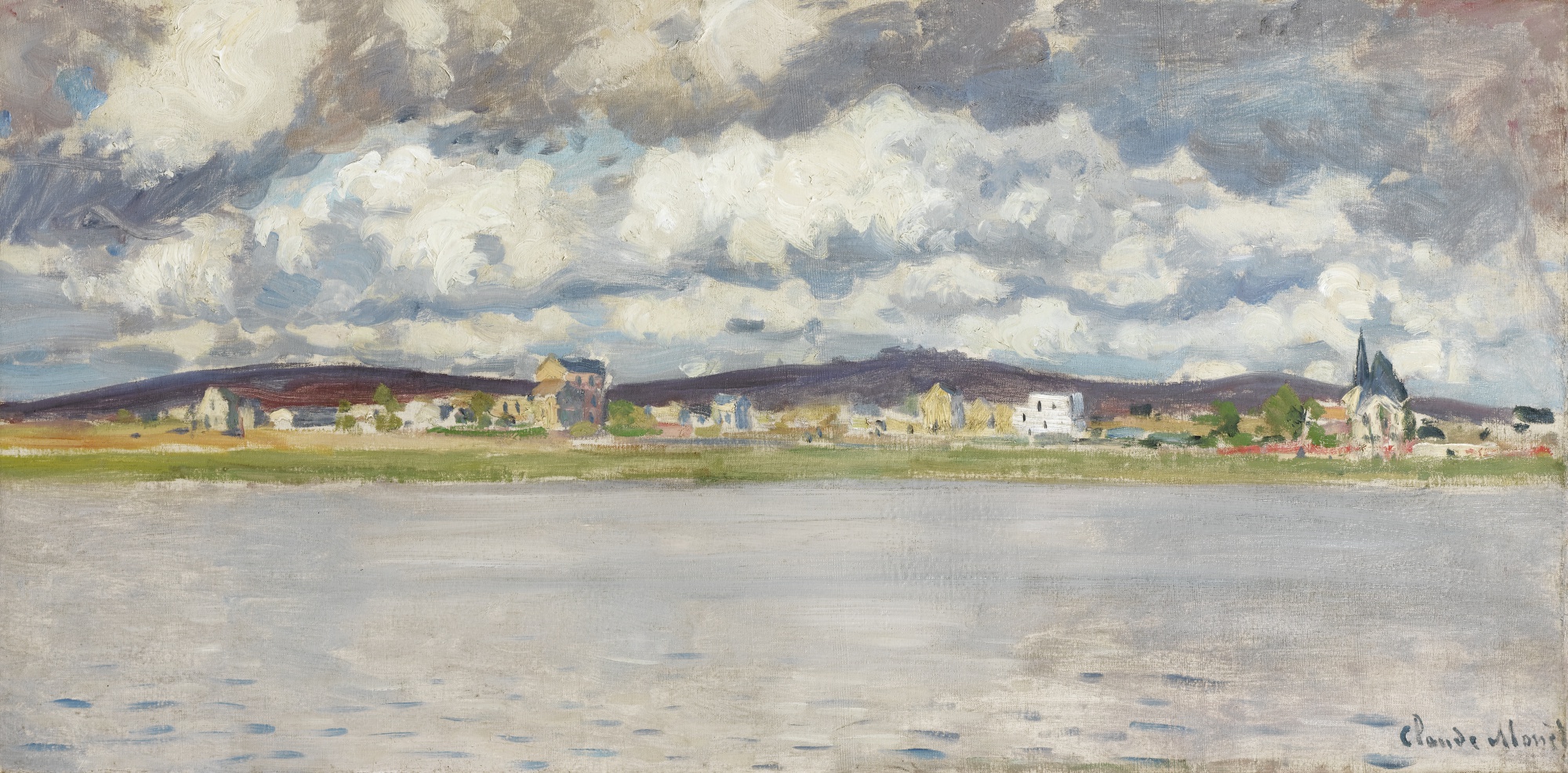
#42
Claude Monet42. View of Argenteuil
Painted in 1872, shortly after Monet settles in Argenteuil, this view adopts a panoramic format. The Seine forms a broad band in the foreground, while houses and the church tower stretch between the water and a cloud-filled sky. The absence of figures and sailing boats focuses attention on the relationships between these three zones. The river’s horizontal brushstrokes contrast with the rounded forms of the clouds. The Sotheby’s catalogue highlights this choice of a peaceful landscape in a town then undergoing industrial transformation. Listed under number Wildenstein 235, the canvas is documented in a private collection at the time of the 2019 sale; its current location is not specified here.
Source: Sotheby’s, catalogue of 29 March 2019, lot 408
View the reference catalogue →
#43
Claude Monet43. The House Seen from the Rose Garden
In this late painting of Giverny, the house can be made out behind dense vegetation. Reds, greens and yellows mingle in thick brushstrokes; a luminous opening enlivens the top of the composition. The building’s outlines matter less than the relationships between the masses of colour. To read the work, you can follow the vertical lines of the trees, then look for the house’s forms through the roses and foliage. This version, held at the Musée Marmottan Monet under number 5086, is dated between 1922 and 1924. Unsigned, it entered the collections with Michel Monet’s bequest in 1966.
Source: Musée Marmottan Monet, catalogue entry 5086
Order a reproduction of this painting →
#44
Claude Monet44. View of Bennecourt
In this view of Bennecourt painted in 1887, Monet places a row of trees between the viewer and the village. Slender trunks divide the surface into vertical bands, while their long shadows cross the green ground diagonally. The pinkish houses are barely discernible through the branches. The almost square format gives as much space to the rhythm of the trees as to the landscape’s depth. Small pink, blue and green brushstrokes connect the sky, branches and grass in the same light. The Columbus Museum of Art holds this oil on canvas under number 1991.001.042.
Source: Columbus Museum of Art, catalogue entry 1991.001.042
Order a reproduction of this painting →
#45
Claude Monet45. Portrait of Monsieur Coqueret (Father)
This portrait depicts Narcisse Coqueret, a compass manufacturer and collector of Monet’s works. His factory was near Vétheuil, where the painter was then living; he notably bought landscapes of the surrounding area from him. Coqueret commissions his portrait in 1880, and Monet also paints his son Paul. The face, turned slightly to the right, stands out against a light grey background. Brushstrokes in the moustache and hair echo the scarf’s blue and white folds, while the brown jacket anchors the lower part of the painting. Held at the Barnes Foundation under number BF725, this painting on canvas was later mounted on a panel.
Source: Barnes Foundation, catalogue entry BF725
Order a reproduction of this painting →
#46
Claude Monet46. Interior, After Dinner
In this interior painted in 1868–1869, Monet studies the light of a domestic evening. Two women sit near a round table, while a man stands by the fireplace. The hanging lamp illuminates the table and white crockery; the fire adds a second area of light on the right. Faces remain loosely detailed and clothing merges into the shadows, directing the eye towards the distribution of light rather than an individual portrait. The table’s ellipse and the chair backs organise the space. Held at the National Gallery of Art, the canvas was donated by Paul Mellon in 1983.
Source: National Gallery of Art, catalogue entry 1983.1.26
Order a reproduction of this painting →
#47
Claude Monet47. View of Bordighera
Monet discovers Bordighera with Renoir in December 1883, then returns alone to the Italian Riviera in early 1884 to paint there. In this canvas, the village appears through pine trees whose winding branches occupy the foreground. The blue sea highlights the pale buildings and green foliage. The eye must pass through the trees to reach the town, giving the landscape its depth. Chicago’s scholarly catalogue reveals a detail of the painting process: Monet moved the church tower from the right to the left of the main trunk as he worked. Signed and dated 1884, this version belongs to the Potter Palmer Collection at the Art Institute of Chicago.
Source: Art Institute of Chicago, scholarly catalogue, entry 1922.426
View the museum catalogue entry →
#48
Claude Monet48. Portrait of Guurtje van de Stadt
Monet paints Guurtje van de Stadt during his stay in Zaandam in the Netherlands in 1871. The seventeen-year-old young woman belongs to a prosperous local family. Turned to the left, she holds her hands together in front of her black dress; the grey-brown background highlights her face and fair hair. The restrained palette contrasts with the landscapes Monet produces during this journey. The Kröller-Müller Museum suggests that these subdued colours could relate to mourning for her recently deceased father. This hypothesis illuminates the context without reducing the portrait to a single interpretation. The work belongs to the collection of the museum in Otterlo.
Source: Kröller-Müller Museum, presentation of the portrait of Guurtje van de Stadt
Order a reproduction of this painting →
#49
Claude Monet49. View of Giverny
In View of Giverny, two haystacks occupy the foreground of a landscape organised into bands: a pale field, village houses, then a cultivated hillside. Red roofs punctuate the white façades, while the greens of the hill contrast with the pinks and yellows of the ground. Look at how the nearby, rounded haystacks give a sense of scale to the small buildings in the background. Visible brushstrokes unite the fields and sky without erasing their differences in texture. The Wikimedia Commons entry, which reproduces an image from the Tehran museum, dates this oil on canvas to 1886 and identifies it under number W1074 in the Wildenstein catalogue.
Order a reproduction of this painting →
#50
Claude Monet50. View of the Church at Vernon
Painted in 1883, the year Monet settles in Giverny, View of the Church at Vernon brings the monument, houses and Seine together in the same clear light. The church rises on the left, while a large house balances the composition on the right. In the lower half, their reflections are fragmented by small horizontal brushstrokes: the architecture retains its solidity on the bank, then becomes vibrations of colour on the water. Compare the pinks and blues of the walls with those of their reflections. This W843 version belongs to the Yoshino Gypsum Collection presented at the Yamagata museum; it differs from Monet’s other views of Vernon painted in 1883.
Source: Yamagata Museum of Art, list of works, Yoshino Gypsum Collection (I-8)
Order a reproduction of this painting →Haystacks, poplars, cathedrals and parliaments turn repetition into a laboratory of seeing.

#51
Claude Monet51. View of the Voorzaan
In this small, very elongated canvas, Monet places sailing boats in the foreground and windmills along a low horizon. Water and sky share ochre, grey and bluish tones that give the landscape atmospheric unity. The dark sails of the two nearby boats stand out clearly, while the buildings in the background are indicated by a few brushstrokes. Look at the difference between these precise silhouettes and the broad brushstrokes of the sky. Painted during Monet’s stay in Zaandam in 1871, View of the Voorzaan belongs to the Musée Marmottan Monet: Roger Hauser bequeathed it to the museum in May 1990. This 18 × 38 cm version differs from the painting held at the Zaans Museum.
Source: Musée Marmottan Monet, View of the Voorzaan, inventory 5239
Order a reproduction of this painting →
#52
Claude Monet52. View of Ventimiglia
In View of Ventimiglia, the green and violet vegetation in the foreground opens onto a blue bay dominated by mountains in lighter tones. The houses of Ventimiglia appear on the right, small against the expanse of the landscape. Look at how Monet creates depth through colour: nearby foliage is dense, while distant landforms merge into the light. This canvas belongs to his three-month stay in Bordighera in 1884. His letters to Alice Hoschedé testify to his difficulty in conveying the brilliant colours of the Mediterranean coast. The painting entered Glasgow’s collections in 1943 through the trustees of the Hamilton Bequest.
Source: Glasgow Museums Collections Online, View of Ventimiglia, inventory 2336
Order a reproduction of this painting →
#53
Claude Monet53. Portrait of an English Painter, Bordighera
This portrait depicts Arthur Burrington, an English painter Monet met in Bordighera. His long brown beard, dark jacket and gaze directed towards the viewer stand out against a pale background crossed by visible brushstrokes. The face is modelled more precisely than the shoulders: observe how the pinks of the skin and shadows around the eyes give the sitter a presence, while the lower bust remains sketched. Monet gives him this canvas in March 1884. The catalogue Monet in Full Light specifies that it remains in Burrington’s family until Durand-Ruel buys it in 1908, then joins the Tel Aviv Museum of Art through a gift from Mrs Halpen.
Source: Monet in Full Light catalogue, portrait of Burrington, p. 199
Order a reproduction of this painting →
#54
Claude Monet54. Landscape at Port-Villez
In Landscape at Port-Villez, the hill overlooks the Seine and small wooded islets. Houses, indicated by a few red roofs, remain discreet between the hillside and the water. Look at the grasses in the foreground: their vertical brushstrokes contrast with the river’s horizontal reflections and lead the eye towards the opposite bank. The dark greens of the trees echo the blues of the water, while the pale sky lightens the mass of the hill. Painted in 1883, at the beginning of Monet’s time in Giverny, this landscape is among the seven works mentioned in a letter to Durand-Ruel in November of that year. It is held at the Museo Soumaya in Mexico City.
Source: Museo Soumaya on Google Arts & Culture, Paisaje en Port-Villez
Order a reproduction of this painting →
#55
Claude Monet55. View of Vétheuil
A path crosses the poppy field and leads the eye towards Vétheuil’s church tower. On the right, a tall poplar stands out against the blue sky; its green and violet brushstrokes echo the grasses in the foreground. This landscape seems to form continuous terrain, but Monet paints it from an island in the Seine: the trees conceal the river separating the viewer from the village. Look at how the small red touches of the flowers enliven the meadow, while clouds open up the upper part of the vertical format. Painted during the summer of 1880, this View of Vétheuil enters the Metropolitan Museum through Julia W. Emmons’s bequest in 1956.
Source: Metropolitan Museum of Art, View of Vétheuil, inventory 56.135.1
Order a reproduction of this painting →
#56
Claude Monet56. View of Voorzan
A large dark sail dominates this view of the Voorzaan near Zaandam. On the left, the green bank projects into the water; on the right, a small vessel with a pale sail balances the central boat. The very elongated format emphasises the breadth of the landscape, while the cloudy sky occupies much of the canvas. Look at the short brushstrokes on the water and the broader masses of clouds: they give the scene two different rhythms. Held at Stockholm’s Nationalmuseum under the title View from Voorzan, the work measures 34 × 73 cm. It was donated to the museum in 1926 by the Nationalmusei Vänner association.
Source: Nationalmuseum, View from Voorzan, inventory NM 2513
Order a reproduction of this painting →
#57
Claude Monet57. Portrait of Victor Jacquemont with a Parasol
Victor Jacquemont, Monet’s childhood friend, stands on a wooded path holding a dark parasol, with a dog beside him. His brown suit, striped shirt and pale hat contrast with the greens of the foliage. Look at the patches of light on the path: they give the avenue depth, while the parasol isolates the sitter’s face. Monet confirms Jacquemont’s identity in a letter of 23 January 1907 to Bernheim-Jeune. The Kunsthaus dates this canvas to 1865–1867. Long held in Zurich, it was sold after an agreement with Carl Sachs’s heirs; its current location is not specified in the reference consulted.
Source: Kunsthaus Zürich, Man with a Parasol, inventory 2334 · Provenance history and agreement with the Sachs heirs
Order a reproduction of this painting →
#58
Claude Monet58. Saint-Lazare Station, Exterior View
Curving tracks lead the eye towards the locomotives, whose steam blurs the buildings in the background. On the right, dark sheds and their frameworks give firm structure to this blue and violet atmosphere. Small figures punctuate the platforms and convey the station’s activity. Look at the contrast between the metal’s sharp lines and the soft brushstrokes of the clouds of steam: Monet treats an industrial site as a changing landscape of light. Painted in Paris in 1877, this exterior view, W446, belongs to his series of twelve Saint-Lazare paintings. The Christie’s catalogue documents its provenance in the Nancy Lee and Perry R. Bass Collection before the June 2018 sale; its current location is not specified there.
Source: Christie’s, Saint-Lazare Station, Exterior View, sale of 20 June 2018, lot 25 B
Order a reproduction of this painting →
#59
Claude Monet59. View of Cap d’Antibes
A rounded tree stands out in the foreground against the Mediterranean, whose intense blue contrasts with the pink and mauve mountains on the horizon. A few small white sails give a sense of scale to the expanse of water. Look at the short brushstrokes across the foliage and ground: they make the greens, ochres and pinks shimmer, while the snow-covered peaks remain lighter. Painted in 1888, this View of Cap d’Antibes reflects Monet’s work on the colours of the Mediterranean coast. Alfred Atmore Pope acquires it in 1889 from Boussod, Valadon et Cie in Paris. It is now part of the Hill-Stead Museum collection in Farmington.
Source: Hill-Stead Museum, View of Cap d’Antibes · History of the Pope Collection
Order a reproduction of this painting →
#60
Claude Monet60. Landscape at Giverny, Snow Effect
In Landscape at Giverny, Snow Effect, Monet observes the village in winter: the red-brown roofs in the foreground contrast with the pale expanses covering the ground. Bare trees and distant houses trace a dark line beneath the pale sky. The snow combines cream, pinkish and violet tones; coloured shadows give it volume. The eye moves from the nearby roofs towards the fields and trees, following the landscape’s horizontal bands. Dated 1886 by the Hecht Museum, this oil on canvas depicts the surroundings of Giverny, where Monet settled in 1883.
Source: Hecht Museum, French painting collection
Order a reproduction of this painting →
#61
Claude Monet61. View of the Sea
Painted in Pourville in 1882, View of the Sea places the viewer above the cliffs. Their green and brown masses frame an opening that draws the eye towards the water; the sea fills the background without a visible horizon. Sailing boats, reduced to small brushstrokes, establish the scale of this downward view. Monet varies the greens, blues and violets to convey reflections on the water’s surface. The Nationalmuseum identifies the site as Hautot-sur-Mer and holds this canvas under number NM 2122. A consortium of donors gave it to the museum in 1919.
Source: Nationalmuseum, catalogue entry NM 2122
Order a reproduction of this painting →
#62
Claude Monet62. The Artist’s House Seen from the Rose Garden
In this late view of his house at Giverny, Monet almost makes the architecture disappear behind the garden. A yellow and pink area suggests the façade amid vegetation painted in broad green, red and violet brushstrokes. The orange ground closes the bottom of the composition, while foliage surrounds the house and blurs its outlines. The Musée Marmottan Monet dates this canvas to 1922–1924 and records the signature “Claude Monet 22” at the lower left. Held under number 5108, it comes from Michel Monet’s bequest acquired in 1966. This reference distinguishes this version from the other houses painted from the rose garden.
Source: Musée Marmottan Monet, inventory 5108
Order a reproduction of this painting →
#63
Claude Monet63. The Seine Seen from the Heights of Chantemesle
This small 1881 canvas offers a downward view of the Seine and its hillsides. Pale rocks in the foreground occupy the right of the painting; their blue shadows echo the river winding on the left. Between these two areas, the greens of the banks and hills lead the eye into the distance. Broad, visible brushstrokes give this 17 × 23 cm landscape particularly free handling. The Joconde entry also mentions its former title, The Amphitheatre of the Hillsides, and the reference Wildenstein 671. Formerly in Blanche Hoschedé’s collection, the work belongs to the French state and has been on deposit in Rouen since 1952.
Source: French Ministry of Culture, Joconde catalogue entry 07290021548
Order a reproduction of this painting →
#64
Claude Monet64. Landscape: Parc Monceau
Monet paints this view of Parc Monceau in spring 1876, among three paintings devoted to this Parisian garden. A flowering tree occupies the centre-left; the lawn shifts from shade to sunshine, while walkers appear between the trunks. The building visible on the left reminds us that this landscape is in the heart of Paris, on Boulevard de Courcelles. Pink touches in the flowers and variations of green convey the spring light. Shown at the Impressionist exhibition of 1877, this version is held at the Metropolitan Museum of Art under number 59.206. It differs from the view of the same park painted in 1878, also held at the museum.
Source: Metropolitan Museum of Art, catalogue entry 59.206
Order a reproduction of this painting →
#65
Claude Monet65. View of the Water-Lily Pond with a Willow
The willow dominates this view of Giverny’s water garden: its long green and blue branches descend to the pond, where water lilies form small pale touches. Yellow reflections brighten the left of the painting and contrast with darker areas of water. Monet contrasts the foliage’s vertical lines with horizontal groups of flowers, without a horizon to close the space. The Christie’s catalogue identifies this canvas as Wildenstein 1866, dates it to around 1917–1919 and specifies that the signature is a stamp. Its provenance includes the collection of actor Edward G. Robinson, who acquires it in 1960. This historical sale entry does not specify its current location.
Source: Christie’s, sale catalogue, Wildenstein 1866
Order a reproduction of this painting →
#66
Claude Monet66. Antibes, the Fort
From Ponteil Beach, Monet depicts the old town of Antibes against the snow-covered Alps. Towers and ramparts occupy the left of the painting; the blue and green sea stretches across the foreground beneath a wide-open sky. The town’s pinks, ochres and whites echo the peaks in the background. The Museum Barberini emphasises that Monet lightens his colours with white to convey the intensity of Mediterranean light. Signed and dated “Claude Monet 88” at the lower left, this canvas corresponds to Wildenstein 1161a. It measures 65 × 81 cm and belongs to the Hasso Plattner Collection presented at the Museum Barberini.
Source: Museum Barberini, catalogue entry MB-Mon-25
Order a reproduction of this painting →
#67
Claude Monet67. The Four Trees
Four poplar trunks cross this almost square composition and extend into reflections in the Epte. The bank forms a horizontal band contrasting with their vertical lines; pink, yellow and blue brushstrokes enliven the trees and water. Monet paints this view in 1891 from a boat fitted out to carry several canvases. According to the Met, he pays a timber merchant to delay felling the poplars so he can finish his series. Fifteen of these paintings are exhibited together in Paris in 1892. The Four Trees enters the museum with the Havemeyer bequest in 1929; its inventory number identifies this version precisely.
Source: Metropolitan Museum of Art, catalogue entry 29.100.110
View the museum catalogue entry →
#68
Claude Monet68. Landscape on Île Saint-Martin
A narrow path crosses the flower-filled meadow and leads towards the trees in this 1881 landscape. The tall poplar on the right gives the painting its vertical thrust, while red touches of flowers enliven the grasses in the foreground. Behind the row of trees, the Museum Barberini identifies the pale church tower of Vétheuil, the village where Monet settled in 1878. Human presence can thus be read in the path and distant architecture. Signed and dated “Claude Monet 81” at the lower left, this canvas appears at the 1882 exhibition of independent artists under the title Summer Landscape, Île Saint-Martin. It now belongs to the Hasso Plattner Collection.
Source: Museum Barberini, catalogue entry MB-Mon-10
Order a reproduction of this painting →
#69
Claude Monet69. Poppy Field near Giverny
The red and green field stretches before Giverny’s houses and the hills framing the village. Broad diagonal brushstrokes enliven the clouds, while trees form a darker band between the flowers and hillsides. This 1885 canvas differs from the Poppies painted in Argenteuil in 1873: it depicts the surroundings of Giverny, where Monet has lived since 1883. Orsay notes that its attribution was debated before its inclusion in the Wildenstein catalogue. Recovered in Germany after the Second World War, the work bears the number MNR 639 and is on deposit in Rouen. The museums publish slightly different dimensions: 65.5 × 81 cm at Orsay, 66 × 81.5 cm in Rouen.
Source: Musée d’Orsay, MNR 639 · Musée des Beaux-Arts de Rouen
Order a reproduction of this painting →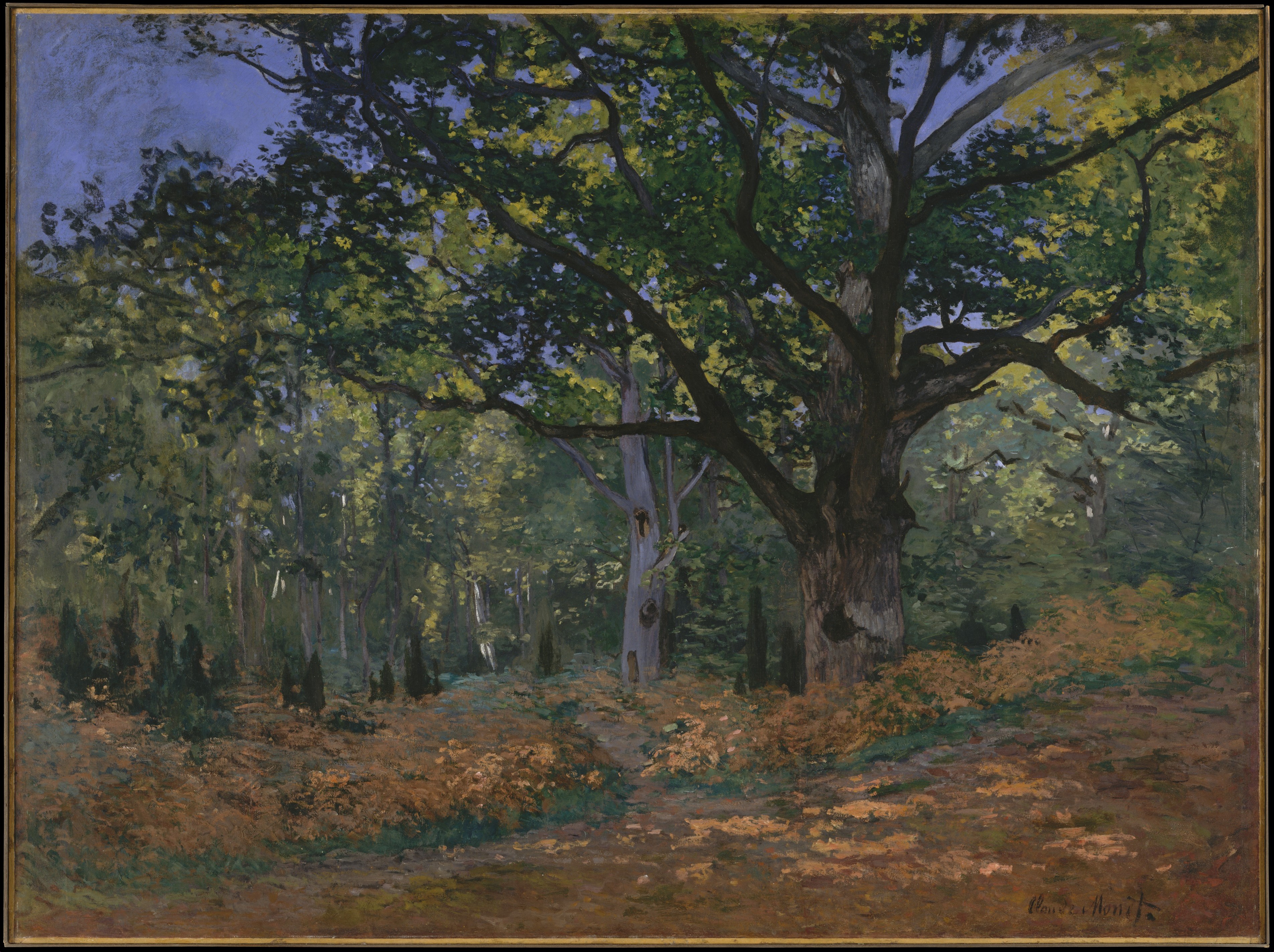
#70
Claude Monet70. The Bodmer Oak, Fontainebleau Forest
The oak’s powerful trunk occupies the right of the painting and spreads its branches over the undergrowth. Yellows and greens brighten the foliage, while reddish leaves on the ground herald autumn. Monet paints this view at the end of his stay in Fontainebleau in 1865. The Met explains that the tree bears the name of Swiss painter Karl Bodmer, who exhibited a depiction of it at the Salon of 1850. The museum tentatively associates this canvas with the landscapes preparing for Luncheon on the Grass. It offers a glimpse of a Monet still drawn to Fontainebleau’s great trees, before the Giverny series. Its inventory number is 64.210.
Source: Metropolitan Museum of Art, catalogue entry 64.210
View the museum catalogue entry →
#71
Claude Monet71. Landscape, Varengeville
Painted in 1882, Landscape, Varengeville shows the Normandy coast behind a screen of scattered trees. Their trunks cross the horizon and connect the vegetation in the foreground with the broad pale sky. Between the branches, the sea forms a blue band; on the right, illuminated cliffs create a second route for the eye. Green, yellow and brown brushstrokes give the ground a denser texture than the water and sky. This contrast between surfaces gives the painting its interest: the seascape is discovered through vegetation rather than from an entirely unobstructed viewpoint. The work is held at the Pola Museum of Art in Hakone.
Source: Pola Museum of Art, catalogue entry for the work
Order a reproduction of this painting →
#72
Claude Monet72. View of the Plain at Argenteuil, Hills of Sannois
In this view painted in 1872, Monet observes the Argenteuil plain from the hills of Sannois. A path descends between the trees towards two tiny figures, then the eye reaches the buildings and church tower in the distance. The vast grey sky occupies almost half the canvas; its hues continue into the town’s muted tones. In the foreground, green and ochre brushstrokes make the grasses more present than the distant buildings. This landscape favours depth and diffuse light over leisure on the Seine. Held at the Musée d’Orsay under number MNR 855, the painting was recovered in Germany after the Second World War and entrusted to the care of the national museums in 1951.
Source: Musée d’Orsay, catalogue entry MNR 855
Order a reproduction of this painting →
#73
Claude Monet73. Seascape by Moonlight
This Seascape by Moonlight, titled A Seascape, Shipping by Moonlight in the Scottish catalogue, depicts the port of Honfleur around 1864. The moon remains concealed by clouds, but bright openings in the sky and their reflections reveal its presence. A dark sailing boat in the foreground echoes the steamship on the left; the lighthouse on the right adds a second source of light. The National Galleries of Scotland emphasise the combined use of palette knife and brush in this early work. Strong contrasts and visible paint give the night a dramatic intensity, very different from the light-filled landscapes that will make Monet famous.
Source: National Galleries of Scotland, catalogue entry NG 2399
Order a reproduction of this painting →
#74
Claude Monet74. View of the Village of Giverny
In this 1886 view, Monet looks at Giverny from an elevated position northeast of the village. Red and pink roofs occupy the foreground, while trees, fields and blue hills form successive bands. The edges of the houses structure the composition as much as the touches of colour: the village becomes a collection of interlocking forms. The Christie’s catalogue notably identifies the Ferme de la Côte and compares this scene with the village under snow painted the same year. This W1072 work differs from the View of Giverny W1074. The catalogue mentions a loan to the New Orleans museum from 1977 to March 2018; this does not confirm that it is currently held at that museum.
Source: Christie’s, catalogue entry for work W1072
Order a reproduction of this painting →
#75
Claude Monet75. General View of Rouen
Painted in 1892, this General View of Rouen shows the city from a distance, with the cathedral emerging from the buildings’ grey and pinkish tones. A pale yellow sky dominates the scene; urban details dissolve in very light paintwork. The museum describes a pochade, or quick sketch, rather than a fully finished composition: some areas still reveal the canvas. This lightly painted treatment contrasts with the thick paint of the famous close-up views of the cathedral. Remaining in Monet’s studio, the work bears his studio stamp. The Musée des Beaux-Arts de Rouen states that it displayed the painting in 1994, then acquired it in 1995.
Sources: Musée des Beaux-Arts de Rouen and Joconde database, inventory 1995.7.1
Order a reproduction of this painting →The garden, Japanese bridge and water-lily pond lead painting towards an almost abstract immersion.

#76
Claude Monet76. Pleasure Boats
In Pleasure Boats, painted between 1872 and 1873, Monet depicts sailing boats moored on the Seine at Argenteuil. Masts divide the pale sky and extend into the water through irregular reflections. A white sail on the left draws the eye towards the opposite bank, while dark hulls and trees anchor the scene on the right. Small horizontal brushstrokes convey the water’s shimmer: the painting’s interest lies in this subtle movement within an almost motionless harbour. The Musée d’Orsay holds this canvas, RF 2437, donated by Ernest May in 1923. Its catalogue entry notes a triptych display with landscapes by Sisley and Pissarro.
Source: Musée d’Orsay, catalogue entry RF 2437
Order a reproduction of this painting →
#77
Claude Monet77. View at Rouelles
View at Rouelles belongs to Monet’s early years: he paints this Normandy landscape in 1858, aged seventeen, alongside Eugène Boudin. An expanse of water reflects trees in the foreground; beyond it, the meadow opens beneath a row of poplars and a blue sky dotted with clouds. Dark masses of foliage frame the luminous lawn. MuMa presents this canvas as Monet’s first publicly displayed painting, at Le Havre’s municipal exhibition in 1858, bearing the signature “O. Monet”. It reflects his apprenticeship in outdoor painting, long before the Giverny series. The museum lists a Japanese collection, Marunuma Art Park, with the work on deposit in Saitama.
Source: MuMa Le Havre, “Monet in Le Havre” exhibition trail · Image: Wikimedia Commons, public-domain reproduction
View the museum catalogue entry →
#78
Claude Monet78. The Ice Breakup at Vétheuil, with a View of Lavacourt
An ice breakup is the breaking and movement of ice on a river. In this 1880 canvas, Monet observes the Seine at Vétheuil, with Lavacourt on the opposite bank. White and bluish ice floes occupy the foreground; their angular outlines contrast with the more fluid reflections of the open water. On the right, bare trees frame the distant village, while a small boat establishes the landscape’s scale. The painting shows a transitional stage of winter, when ice and water coexist. Entering the national collections in lieu of tax in 1976, it belongs to the Musée d’Orsay and is on deposit in Lille. C2RMF documents its restoration in late 2025 and a study investigating a possible underlying composition.
Sources: Musée d’Orsay, catalogue entry RF 1976 20 and C2RMF, technical study
Order a reproduction of this painting →
#79
Claude Monet79. Winter Landscape in the Val de Falaise (Giverny)
This 1885 landscape shows the Val de Falaise near Giverny through pruned trees whose trunks stand out against the hillside. The meadow remains vivid green: the winter title therefore does not mean that the entire scene is covered in snow. Cut branches, the foreground fence and pale-walled houses give this view a specific rural character. Monet contrasts the trees’ vertical lines with the hill’s diagonal slope; the ground’s ochres and greys highlight the blue sky. Signed and dated in red at the lower left, this W975 canvas belongs to the Merzbacher Collection, on permanent loan to Kunsthaus Zürich.
Source: Kunsthaus Zürich, collection entry MB 0007 (PDF)
Order a reproduction of this painting →
#80
Claude Monet80. Amsterdam, the Bridge
In The Bridge, Amsterdam, Monet depicts the Peperbrug drawbridge over the Rapenburgwal, with the Montelbaanstoren tower in the background. Dark piers and the mechanism’s arms structure the scene, while their reflections fragment in the water. Small figures on the bridge bring this architecture to life beneath a grey sky. Dating varies between references: the Shelburne Museum caption gives 1870–1871, while the chronology published by the Art Institute of Chicago gives 1874. Shelburne also recounts Louisine Havemeyer’s purchase of the painting in 1877, on Mary Cassatt’s advice, for 300 francs. This canvas thus holds an important place in the history of Monet’s American reception.
Sources: Shelburne Museum, “Mary Cassatt’s Impressions” exhibition and Art Institute of Chicago, Monet chronology (PDF)
Order a reproduction of this painting →
#81
Claude Monet81. Autumn at Jeufosse
Painted in 1884, Autumn at Jeufosse transforms a view of the Seine into a study of complementary colours. On the left, orange trees extend into the water; on the right, the green bank follows the river’s curve towards bluish hills. Red, violet and yellow brushstrokes remain visible within the foliage, while the central water offers a calmer surface. The Museum Barberini emphasises the shimmer produced by these juxtaposed colours and their reflections. This version, referenced W916 and signed “Claude Monet 84” at the lower left, belongs to the Hasso Plattner Collection. Its number, MB-Mon-17, distinguishes it from Monet’s other views of Jeufosse painted the same year.
Source: Museum Barberini, catalogue entry MB-Mon-17
Order a reproduction of this painting →
#82
Claude Monet82. Fishing Boats
Two large reddish-brown sails stand out against a blue-green sea, while small vessels recede towards the horizon. In the foreground, pale curved brushstrokes give the water a shifting surface; the sail on the right cuts diagonally across this space and brings the boat closer to the viewer. In Fishing Boats, Monet thus conveys the combined movement of sea and vessels through rapid painting. The Van Gogh Museum catalogue stresses that this sketch-like appearance does not mean the canvas is unfinished: the artist signed it as a completed work. This freedom of handling, now central to his style, displeased some contemporary critics.
Source: Van Gogh Museum, Impressionism exhibition texts, p. 18.
Order a reproduction of this painting →
#83
Claude Monet83. Chrysanthemums
The bouquet spills towards the left, while a large pale space opens on the right. White, yellow and pinkish petals echo the red vase and the small flowers in the wall decoration: Monet builds the still life through contrasts of colour and density. The horizontal ledge at the bottom stabilises this profusion, and bluish shadows make the flowers more luminous. Signed on the left and dated 1878 on the right, this painting offers a close-up subject on which to observe his lively brushwork. Doctor Paul Gachet buys it from the artist in December 1878; his son donates it to the national museums in 1951. The work now belongs to the Musée d’Orsay’s collections.
Source: Musée d’Orsay, Chrysanthemums, catalogue entry 1299.
Order a reproduction of this painting →
#84
Claude Monet84. Étretat
The dark cliff occupies the left half of this small canvas, while the bluish-grey sky and sea open up the space on the right. In the foreground, rocks and pools trace an irregular route towards the opening at the foot of the cliff. Its vertical reflection connects the stone masses with the calm water; a few pinkish hues enliven the sky without disrupting the restrained tonality. This view of Étretat, dated to around 1864 by the Peindre en Normandie Collection, shows a Monet still far removed from his great series of the 1880s. Its 27 × 41 cm format invites us to examine relationships of light and texture on an intimate scale.
Source: Peindre en Normandie Collection, newsletter no. 1, January 2021, p. 6.
Order a reproduction of this painting →
#85
Claude Monet85. Bordighera, Italy
Two pine trees with winding trunks frame Bordighera’s red roofs and church tower, with the sea in the background. Their branches extend beyond the frame, while green and violet brushstrokes blur the details of nearby vegetation: the eye passes through this paint to reach the illuminated town. Monet paints this view from the Collina dei Mostaccini, west of the town, during his Italian stay in 1884. The Museum Barberini compares this framing with photographic landscapes then circulated among travellers. Signed and dated at the lower right, this canvas belongs to the group of twenty-one Bordighera views purchased by Paul Durand-Ruel in June 1884.
Source: Museum Barberini, Bordighera, Italy, MB-Mon-13.
Order a reproduction of this painting →
#86
Claude Monet86. The Customs Officer’s Cottage
The small house with an ochre roof appears on the left, almost absorbed by the cliff’s tall grasses. On the right, a fence follows the terrain and leads the eye towards the vast green sea, dotted with pale brushstrokes. The high horizon reduces the sky to a band and emphasises the downward view: the space shifts abruptly from the nearby slope to the maritime expanse. Monet paints this cottage between Pourville and Varengeville in 1882, varying viewpoints and atmospheric conditions. The Auckland City Art Gallery catalogue identifies this version held in Newark as W733. It compares its framing with the Japanese prints Monet collected, without reducing the composition to mere imitation.
Source: Auckland City Art Gallery, Monet: Painter of Light, 1985, no. 10, p. 60.
Order a reproduction of this painting →
#87
Claude Monet87. Basket of Grapes, Quinces and Pears
A pale basket filled with grapes occupies the centre of this vertical still life. Its handle forms a curve before the yellow fruits arranged above, while dark bunches on the right and in the foreground contrast with the ochre table. Monet models the grapes with small pink, green and blue brushstrokes: colour conveys their roundness without enclosing each fruit in a sharp outline. The wicker echoes this fragmented brushwork and gives the basket a luminous texture. The title “Caches of Grapes” was inappropriate: the image corresponds to the Basket of Grapes, Quinces and Pears, listed under W954. The Wikimedia entry documents its inventory at the Columbus Museum of Art and its dating to 1883.
Order a reproduction of this painting →
#88
Claude Monet88. The Zuiderkerk and the Groenburgwal Canal in Amsterdam
The Zuiderkerk tower dominates the axis of the Groenburgwal canal, between the façades and trees along both banks. A boat in the foreground and the bridge further away establish distances, while the large yellow beam on the left introduces a diagonal into this urban perspective. Monet enlivens the water with blue and pale brushstrokes that fragment the buildings’ reflections; the figures of passers-by remain discreet. The generic title Canal in Amsterdam is insufficient to identify the view: the Philadelphia Museum of Art calls it The Zuiderkerk, Amsterdam (Looking up the Groenburgwal) and dates it to around 1874. This detail distinguishes the painting from Monet’s other canals and views of Amsterdam.
Source: Philadelphia Museum of Art, The Zuiderkerk, Amsterdam, catalogue entry 104453.
Order a reproduction of this painting →
#89
Claude Monet89. Church at Vétheuil
The church façade and tower dominate the village houses in a horizontal composition. The pale house with blue shutters, right of centre, conceals part of the monument and connects the architecture with everyday life. A few figures punctuate the street; in the foreground, green, white and ochre brushstrokes give the stones and ground an irregular surface. This version is listed under number W473 and dated 1878 in Wikimedia documentation. It should be distinguished from the vertical views held in Edinburgh and at the Musée d’Orsay. Its current location is not confirmed here: identifying the church motif is not enough to assign every version to the same collection.
Documentary reference: Wikimedia Commons, Church at Vétheuil, W473.
Order a reproduction of this painting →
#90
Claude Monet90. Wheatfield
A narrow path crosses the grasses in the foreground and leads towards a band of golden wheat. Groups of poplars raise their green and blue silhouettes above the low horizon, while a vast sky crossed by thin clouds occupies most of the canvas. A few red brushstrokes punctuate the nearby vegetation and echo the field’s orange hues. In this 1881 landscape, Monet enlivens a very simple structure through varied brushstrokes and colours. The Museum Barberini emphasises the path’s role in guiding the eye and the cirrus clouds’ role in bringing dynamism to the space. Signed and dated at the lower left, the painting appears at the seventh Impressionist exhibition in 1882.
Source: Museum Barberini, Wheatfield, MB-Mon-09.
Order a reproduction of this painting →
#91
Claude Monet91. In a Norwegian Boat
Three young women occupy a boat with dark sides: one stands on the left, while the other two sit. Their pale dresses and hats stand out against dense vegetation, then reappear in the water as slightly distorted reflections. Two almost vertical oars connect the hull with this second, inverted scene. Without a visible horizon, Monet focuses the eye on relationships between figures, vessel and reflective surface. The Musée d’Orsay identifies Suzanne, Blanche and Germaine Hoschedé among the people depicted. Also titled The Boat at Giverny, the painting is dated to around 1887; it comes from the bequest of Princess Edmond de Polignac, née Winnaretta Singer.
Source: Musée d’Orsay, In a Norwegian Boat, catalogue entry 1179.
Order a reproduction of this painting →
#92
Claude Monet92. Oat Field
Red poppies punctuate the pale field, crossed by broad bluish shadows. On the right, a dark mass of trees cuts into the sky and gives the plain depth; further away, a row of trees softens in the light. Monet builds this view of Giverny through contrasts of warm and cool brushstrokes rather than detailed outlines. The title “Champagne” was incorrect: the image corresponds to the Oat Field of 1890 held at the Harn Museum of Art. The museum states that it received the work in 1999 through a gift from Michael A. Singer. This landscape belongs to Monet’s explorations of the fields around Giverny as he develops his series of the 1890s.
Source: Harn Museum of Art, modern art collection, Oat Field.
Order a reproduction of this painting →
#93
Claude Monet93. Poppy Field
Poppies appear as a multitude of small red touches among green and bluish grasses. The low horizon gives ample space to the pale sky, while an isolated poplar on the right breaks the field’s horizontality. Other, more distant trees establish the scale of this plain without interrupting its openness. Monet does not describe every flower: he brings the motif into view through the rhythm of colours and brushstrokes. The title “Fields of Papillae” was an error; Museum Boijmans Van Beuningen identifies this canvas as Poppy Field, painted in Vétheuil in 1881. It enters the museum’s collections in 1958 with the collection of D. G. van Beuningen.
Source: Museum Boijmans Van Beuningen, Poppy Field, inventory 2611 (MK).
View the museum catalogue entry →
#94
Claude Monet94. Woodland Path
A narrow path leads between the trees, from the bottom of the canvas to a dark opening in the centre. Its pale areas guide the eye amid deep greens and browns; higher up, a tree with golden foliage and a few fragments of cloudy sky brighten the composition. The vertical format gives height to the trunks and narrows the walk, without a broad horizon. Painted in 1865, this Woodland Path belongs to Monet’s early landscapes. The Arp Museum curators present it as a work preceding the establishment of Impressionism. It forms part of the Rau Collection for UNICEF under number GR 1.844, documented in its loans catalogue.
Source: UNICEF Deutschland, catalogue of loans to the Arp Museum, Waldweg, GR 1.844. Interview with the curators.
Order a reproduction of this painting →
#95
Claude Monet95. Twilight in Venice
On the left, the bell tower and dome of San Giorgio Maggiore stand in silhouette against orange and red light. Their dark reflection descends into the lagoon, where horizontal yellow, green and blue brushstrokes suggest ripples. In the sky, the paint follows more curved movements: this difference in handling distinguishes air from water despite their shared palette. The Artizon Museum dates this version to around 1908 and recalls that Monet discovers Venice with Alice in late September of that year. Captivated by the city, he extends his stay and produces around thirty paintings in two months. Here, the monument serves mainly as a reference point for observing backlighting and the colours of sunset.
Source: Artizon Museum, Twilight, Venice, catalogue entry 22492.
Order a reproduction of this painting →
#96
Claude Monet96. Women in the Garden
Four women in pale dresses occupy a garden crossed by sunlight and shade. The central tree organises the scene, while the path curves around the seated figure and leads towards the woman picking flowers on the right. The white fabrics also carry the foliage’s shadows: Monet integrates the figures into the landscape through light. Camille Doncieux poses for the three figures on the left. Begun outdoors in 1866 in Ville-d’Avray, this large canvas requires the painter to dig a trench to lower the stretcher and reach its upper section. Completed in the studio, it is rejected from the Salon of 1867. The Musée d’Orsay retains a cautious dating of around 1866 and documents its purchase from Monet by the French state in 1921.
Source: Musée d’Orsay, Women in the Garden, catalogue entry 807.
Order a reproduction of this painting →
#97
Claude Monet97. In the Meadow
Camille Monet reads, almost enveloped by tall grasses and flowers. Her pale hat and open book draw the eye; the green parasol at the upper right extends the vegetation. Yellow, white and violet brushstrokes make this meadow shimmer, while the dress merges into the shadows. Painted in Argenteuil in 1876, this painting favours a moment of family intimacy and very close framing. Théodore Duret lends it to the third Impressionist exhibition in 1877. The Christie’s entry identifies this version, referenced W405, but does not confirm its current location.
Source: Christie’s, In the Meadow: entry and history of the work.
Order a reproduction of this painting →
#98
Claude Monet98. The Church at Vernon, Fog
The collegiate church of Vernon emerges on the left from a veil of mist. Trees and riverside houses dissolve into blue-green tones, while their reflections occupy almost the entire lower half of the painting. A few horizontal marks, including a small boat on the left, interrupt this floating image. Monet thus uses fog to bring architecture, vegetation and water together: outlines fade, but their masses remain legible. The Rosengart Collection in Lucerne specifies that this work was painted in 1894 despite the date of 1893 inscribed by the artist. This discrepancy explains the two years found in references.
Source: Rosengart Collection, presentation of Claude Monet and The Church at Vernon, Fog.
Order a reproduction of this painting →
#99
Claude Monet99. Ice Floes at Bougival
Pale ice floes drift on a grey Seine, bordered on the right by a snow-covered path. Beached boats, stakes and figures enliven the foreground; bare trees on the opposite bank are reflected in the dark water. The sky occupies ample space and reduces contrasts in the distance. Monet thus builds a winter landscape in which everyday actions establish the river’s scale. The Bougival tourist office places the painting in the winter of 1867–1868; the Louvre and Joconde databases give broader date ranges. The Lyon donation is made in 1961, with the work physically entering the museum in 1977.
Sources: Louvre, Ice Floes at Bougival ; Joconde, inventory RF 1961 62 ; Bougival tourist office, winter dating.
Order a reproduction of this painting →
#100
Claude Monet100. Still Life: A Quarter of Meat
A quarter of meat occupies almost the entire surface of this small canvas. Red flesh and pale areas of fat stand out against a very dark brown background; a pot on the left and garlic in the foreground complete the composition. Thick brushstrokes make the substance palpable, while the ochre table stabilises this collection of irregular forms. Dated to around 1864 by the Musée d’Orsay, the work shows the young Monet confronting a studio subject and powerful contrasts. It enters the national collections through Étienne Moreau-Nélaton’s donation in 1906, before being assigned to Orsay in 1986.
Source: Musée d’Orsay, Still Life: A Quarter of Meat. Image: Wikimedia Commons, reproduction of a public-domain work.
View the museum catalogue entry →What the Works Reveal
One Hundred Paintings, Three Ways to Capture the Moment
After one hundred works, Monet seems less obsessed with pretty landscapes than with a very precise question: how can you paint something that changes before the canvas is even finished? His answer lies in the series, the brushstroke and remarkable patience with the whims of the sky.
The Motif Is Only a Beginning
A station or cathedral matters above all as a surface on which light can produce its variations.
The Series Replaces the Definitive Image
Each version challenges the idea that a place could be reduced to a single appearance.
Water Reorganises the World
Reflections, depth and surface merge until the eye wavers between landscape and pure painting.
A Timeline along the Water
Five Dates to Follow Monet
Claude Monet grows up in Le Havre, where the sea, sky and Eugène Boudin shape his eye from an early age.
Impression, Sunrise is exhibited at Nadar’s and unwittingly gives the Impressionist movement its name.
Monet rents and later buys the house whose garden will gradually become his main open-air studio.
Haystacks, poplars and cathedrals systematically reveal variations in light and atmosphere.
The large Water Lilies decorations open to the public and transform painting into a continuous environment.
The Work in Depth
Claude Monet: Reading a Work through Its Subject, Texture and Era
For Monet, the same subject can become several distinct paintings. Haystacks, Poplars, Rouen Cathedral and the Houses of Parliament in London allow comparisons of light and atmosphere; a shared title is therefore not enough to identify a canvas. The collection, date, dimensions and image must all correspond to the same version.
The early works broaden this reading. The Portrait of Adolphe Monet, A Quarter of Meat and View at Rouelles show explorations of the face, texture and landscape before the great series. The Argenteuil scenes then bring together family life, leisure and the transformations of the Paris suburbs.
Settling in Giverny in 1883, Monet buys his property in 1890. The garden and pond become motifs he can observe and transform. In the late Water Lilies, the horizon may disappear: reflections, plants and the water’s surface then organise the space of the painting.
The entries primarily refer to museums, exhibition catalogues or documented sale records. When only a secondary reference is accessible, it is named. A historical collection does not prove the current location; an approximate date should not become a certain year. These limitations are retained in the texts.
To choose a reproduction, first compare palette and composition: the blues and greens of a pond, the contrasts of a snowy landscape or the warm colours of a still life produce different effects. Then check the available size and the viewing distance on your wall.
References: Claude Monet’s House and Gardens, dossier on Giverny ; Musée de l’Orangerie, the Water Lilies.
Four Keys to Reading the Paintings
Looking without Waiting for the Sky to Settle
Time of day, brushwork, series and reflection provide access to Monet’s method. Behind the apparent spontaneity lies patient construction, reworked until the moment finally seems immediate.
Seeking the Moment
Shadows, mist and colour temperatures often indicate the time more reliably than a watch.
Following the Vibrations
Juxtaposed brushstrokes allow the eye to blend colours and reconstruct the atmosphere.
Comparing the Differences
The same motif reveals the diversity of time when several versions are viewed together.
Questioning Depth
Water layers sky, vegetation and surface until it delightfully blurs their levels.
Atlas of Light
Continuing beyond the Last Reflection
Museums, collections, series and sources place the paintings within Monet’s career. The links remain stable, which gives them a welcome advantage over a cloud above the Seine.
Within Alpha Reproduction
01Claude MonetClaude Monet’s Masters02Claude MonetCollections & guides03All painting reproductionsCollections & guidesMuseums and References
01Wikipedia - Claude MonetMuseum & reference02Wikidata - Claude MonetMuseum & reference03Wikimedia Commons - Claude MonetMuseum & reference04Musée Marmottan MonetMuseum & reference05Musée d’Orsay - Claude MonetMuseum & reference06Musée de l’Orangerie - Water LiliesMuseum & reference07Wikipedia - ImpressionismMuseum & reference08Wikidata - ImpressionismMuseum & reference09Wikimedia Commons - ImpressionismMuseum & referenceFrequently Asked Questions
Monet without Unnecessary Fog
Essential reference points for recognising his periods, understanding the series and choosing among his most famous works.
What are Claude Monet’s best-known paintings?
Impression, Sunrise, Poppies, The Magpie, Water Lilies, Haystacks and the views of Rouen Cathedral are among his most recognisable works and groups of paintings. This selection offers 100 examples to compare subjects and periods; its order is editorial and does not constitute an official popularity ranking.
Why are there several paintings titled Water Lilies?
Water Lilies forms a cycle devoted to the pond in Monet’s garden at Giverny. The works differ in date, dimensions, framing and collection. The Kurashiki and London paintings presented here are two distinct works; the large Orangerie decorations form another group.
What is a series in Monet’s work?
Monet returns to the same motif to explore variations in light, atmosphere and viewpoint. Haystacks, Poplars, Rouen Cathedral and the London views allow these differences to be compared. Works may be reworked in the studio; a series is more than identical copies.
Where can you see Claude Monet’s paintings?
Several originals in this selection belong to the Musée Marmottan Monet, Musée d’Orsay, Metropolitan Museum of Art or Museum Barberini. The Musée de l’Orangerie holds the large Water Lilies decorations. Belonging to a collection does not guarantee permanent display: consult the museum’s catalogue entry and visitor information before a visit.
How can you distinguish two versions of the same subject?
Compare the image, precise title, dating, dimensions and inventory or catalogue number where provided. The churches at Vernon and Vétheuil, ponds and Giverny landscapes exist in several versions. A generic title or similar-looking image is not enough to treat them as the same work.
Why are some dates or collections uncertain?
Sources may suggest an approximate date or different date range. An old sale documents a collection at a particular time without confirming the current owner. The entry indicates these limitations and names its source; it avoids claiming a precision that the references cannot verify.
Are the stated dimensions those of the reproduction?
The dimensions in the entries are those of the original works. Reproduction sizes and specifications can be found on the product page. When choosing, consider the composition, colours, wall size and the distance from which the painting will be viewed.
How can you read a Monet painting without jargon?
Identify the motif and the point that attracts your eye. Then observe the light and dark masses, colours, brushstrokes and reflections. Compare these observations with another version of the subject. The date and context complete the reading, distinguishing what is visible from what is documented.
0 comments